What are Dubai’s new five-star taxi ratings?
Dubai’s taxis now carry a star rating, and you will see it on the screen inside the cab. The Roads and Transport Authority (RTA) launched a five-star system on Sunday 15 November 2026 to rate the performance of the emirate’s five taxi companies. Each company’s score will appear on the smart screens inside its taxis and on a board at the entrance to its headquarters. The rating rests on 18 measures across four pillars: sustainability, technology, accountability and reliability. No company score has been published yet, and RTA has not said when the first scores will appear on screens, so this guide tells you what the system is, how it works and what to look for. Facts checked 28 Nov 2026.
- Launched: Sunday 15 November 2026, by Dubai’s Roads and Transport Authority.
- Rated: five companies, Dubai Taxi Company, Kabi Taxi, National Taxi, Arabia Taxi and Metro Taxi.
- Measured: 18 indicators across four pillars, from green vehicles to peak-hour availability.
- Where you see it: smart screens inside taxis, and rating boards at company headquarters.
- First scores: not published yet, and no date has been given for the first display.
The rating is about the company, not the driver or the single trip. A five-star company has met RTA’s measures across its whole fleet, while a lower rated company has not, and RTA links the score to real rewards and real consequences. The rest of this guide covers who runs the system, what each pillar measures, what companies win or lose, and when the rating should change how you travel.
Who runs the taxi rating system?
RTA runs the rating system. The authority launched it as part of its drive to build a people-centred transport system with clear, measurable standards, and it describes the system as a tool for governing taxi service quality. The score links company performance to customer satisfaction, safety, operational efficiency, innovation and sustainability, and RTA will update the assessment mechanism periodically to keep pace with global developments.
Mattar Al Tayer, Director General and Chairman of the Board of Executive Directors of RTA, said the launch moves RTA from measuring service levels to building an integrated system for continuous improvement. He said the system links incentives to performance results and enhances transparency and competitiveness among operators, so that services stay reliable, safe and smart. The aim, in his words, is service that exceeds customer expectations.
For you as a passenger, the practical point is that one body sets the standard for every licensed taxi in Dubai. There is no separate rating from each company, and no review site sets the score. The number you see on the screen comes from RTA’s own assessment, and the same authority that issues taxi plates and sets the fare rules also decides the stars. If you want the full announcement, read the RTA news page on the five-star rating system. For what RTA runs across the whole network, see the site guide to RTA Dubai.
Which five taxi companies are rated?
Five companies run Dubai’s licensed taxi sector, and all five are rated under the new system. They are Dubai Taxi Company, Kabi Taxi, National Taxi, Arabia Taxi and Metro Taxi. Every licensed taxi in Dubai belongs to one of these five, so whichever taxi you hail at a rank, flag down on the street or book through an app, it sits inside this rating system.
- Dubai Taxi Company, the largest operator in the sector.
- Kabi Taxi, one of the four franchise operators.
- National Taxi, one of the four franchise operators.
- Arabia Taxi, one of the four franchise operators.
- Metro Taxi, one of the four franchise operators.
Careem and Uber are not part of the five. They are ride-hailing services, and RTA’s system rates the licensed taxi companies only, so you will not see a star score for a Careem or Uber car under this system. The distinction matters at the airport and at hotel ranks, where taxis and ride-hailing cars wait side by side. A taxi at the rank belongs to one of the five rated companies. A car booked through a ride-hailing app does not.
The sector is large. In 2025 the total number of taxis exceeded 14,346 vehicles, and the five companies together completed more than 120 million trips carrying over 209 million passengers. The rating therefore covers the whole fleet you are likely to use, not a small trial group, and a change in the scores would touch every taxi journey in the city.
How does the Sustainability pillar work?
Sustainability is the first of the four pillars, and it measures how green each company’s fleet is and how efficiently it uses its cars. RTA scores four indicators under this pillar, and they reward companies that run cleaner vehicles and waste fewer kilometres.
- Green vehicles: the number of electric and hydrogen vehicles in the company’s fleet.
- Drivers to vehicles: the ratio of drivers to vehicles in the company.
- Productive kilometres: the share of kilometres travelled with a passenger on board, against total kilometres travelled.
- Average trip rating: the average rating passengers give their trips.
The productive kilometres measure is the one most passengers never think about. A taxi that drives empty between jobs burns fuel and clogs roads without carrying anyone, so RTA rewards companies whose cars spend more of their time carrying passengers. The green vehicle count pushes the same idea further: a company with more electric and hydrogen cars scores higher, which fits Dubai’s plan to move the whole taxi fleet to electric and hydrogen power by 2040.
For you, the sustainability score shows up in the car itself. The fleet is already mostly green: of the 14,346 taxis running in 2025, 12,380 were electric or hybrid. A high sustainability score means the company is ahead on that shift, with more electric and hydrogen cars and fewer empty kilometres behind each trip.
How does the Technology pillar work?
Technology is the second pillar, and it measures how far each company has moved its bookings and payments onto digital systems. RTA scores four indicators here, and they favour companies whose passengers can book and pay without cash and whose drivers work under a managed system.
- E-hail trips: the number of e-hail trips out of total trips in the sector.
- Electronic payments: the percentage of trips paid for electronically.
- Driver management system: whether the company has a driver management system in place.
- Working-hours policy: how far the driver working-hours policy is implemented.
The e-hail measures matter because they change how you get a taxi. An e-hail booking is a taxi booked through an app, and a company with a high e-hail share is one whose cars you can call up on your phone rather than wait for at a rank. The electronic payment share matters in the same way: a company with more card and app payments is one where you are less likely to need cash at the end of the ride.
The working-hours measure is about the driver, not the app. RTA checks how far each company applies its driver working-hours policy, so a company that lets drivers work over-long shifts scores lower. A tired driver is a safety risk, and this pillar treats driver hours as part of the technology score, because the driver management system is what records and enforces them.
How does the Accountability pillar work?
Accountability is the third pillar, and it is the one that deals most directly with safety and with what happens when things go wrong. RTA scores five indicators here, more than under any other pillar, and they cover accidents, rule breaking, complaints and satisfaction on both sides of the trip.
- Serious traffic accidents: the number of serious accidents involving the company’s taxis.
- Quality violations: the number of quality violations recorded against the company.
- Reckless driving complaints: the number of complaints about reckless driving.
- Customer satisfaction: end-of-trip ratings for e-hail bookings.
- Driver satisfaction: how satisfied drivers are with e-hail.
The accident and complaint measures are the teeth of the system. A company with more serious accidents or more reckless driving complaints scores lower, and that score is public, on the screen in the taxi and on the board at the company’s headquarters. The customer satisfaction measure uses the rating you give at the end of an e-hail trip, so the score partly comes from passengers themselves.
Driver satisfaction sits in this pillar too, because a company that treats its drivers badly tends to lose them, and a high turnover of unhappy drivers shows up in the service you get. RTA measures how satisfied drivers are with e-hail, which is the system most of them now work through, so the pillar looks at the trip from both seats.
How does the Reliability pillar work?
Reliability is the fourth pillar, and it measures whether a taxi is there when you need one. RTA scores four indicators here, and they all come down to availability at busy times and to the state of the car when it arrives.
- Peak-hour availability: how many vehicles are available during peak hours.
- E-hail activation at peak hours: the number of vehicles activated on the e-hail system during peak hours.
- E-hail acceptance rate: how often drivers accept e-hail requests.
- Cleanliness: observations on the cleanliness of the vehicles.
The acceptance rate is the measure most passengers will feel first. When you book a taxi through an app and the driver declines the job, you wait longer and book again, so a company whose drivers accept more requests scores higher. Peak-hour availability works the same way: a company that keeps more cars on the road at rush hour and at airport arrival peaks is more reliable when demand is highest.
Cleanliness closes the pillar. RTA’s assessors record observations on the state of the cars, so a company with dirty or poorly kept vehicles loses points even if its cars are available. Together the four measures answer one question: when you need a taxi, does one turn up, does it accept the job, and is it clean when it does.
Where will you see the rating inside a taxi?
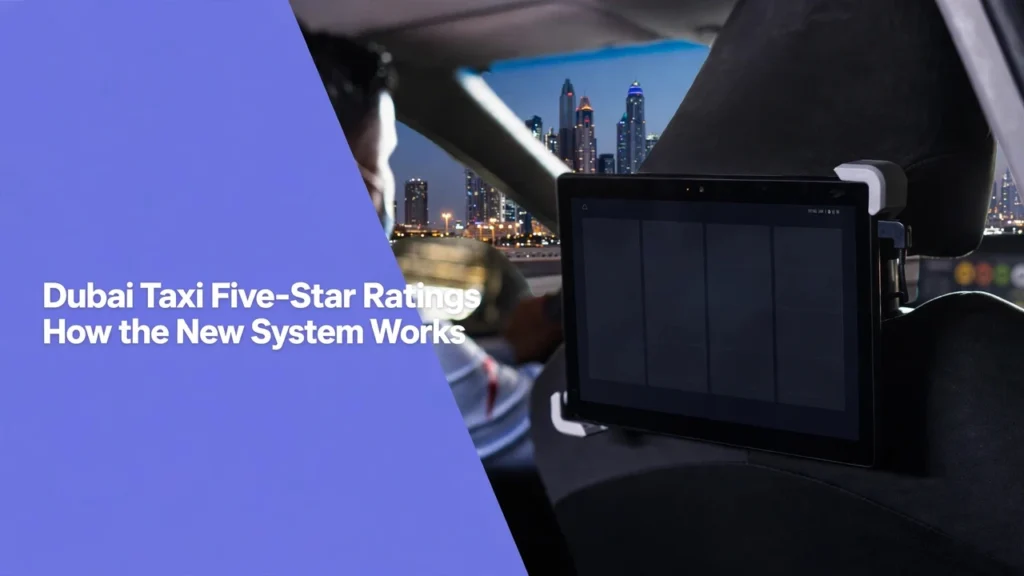
You will see the rating on the smart screen inside the taxi. RTA says company ratings will be displayed on the smart screens in taxis, so the score sits on the screen in the cab where you already see trip details. A rating board will also be placed at the entrance to each company’s headquarters, so the score is public in two places, not hidden in a report.
The screen is the part that matters to you. It is the display you face during the ride, and the company’s star score will sit on it alongside the trip information. That makes the rating visible before you pay and before you rate the trip yourself, so you can judge the company while you are still in its car. The headquarters board is for the company and for visitors to its offices, and it puts the same score on public view at the front door.
One thing is not settled yet. RTA has launched the system, but no date has been given for when the first company ratings will be displayed, and no company score has been published in any source checked on 28 Nov 2026. The display will follow the first assessment, so the screens may not show a score on your next ride. Check the RTA news page for the first published ratings before you treat any score you hear about as official.
Do not expect a star score on your next ride yet. RTA has launched the rating system, but no company score has been published and no date has been given for the first display on taxi screens. If a driver or a website quotes a star score for a Dubai taxi company, treat it as unconfirmed until RTA publishes the first ratings. The scores will appear on the smart screens inside taxis and on boards at company headquarters once the first assessment is complete.
What do taxi companies win for five stars?
A five-star rating pays. RTA links each rating level to a concrete reward, and the reward is more taxis on the road, which is the one thing every taxi company wants. The better the score, the more the company can grow.
| Star rating | What the company receives |
|---|---|
| Five stars | Seven taxi plates, plus a certificate and a trophy from RTA |
| Four stars | Five taxi plates |
| Three stars or fewer | No plates; improvement measures applied by RTA |
A taxi plate is permission to put another taxi on the road, so seven extra plates means seven more cars earning fares for the company. The certificate and trophy add public recognition on top of the growth, and RTA presents them as a mark of leadership in the sector. A four-star company still grows, with five extra plates, but it grows more slowly than a five-star company.
The reward structure is the point of the system. RTA said it linked rating levels to incentives that encourage outstanding companies to maintain their leadership, while lower rated companies face measures to improve. The plates give the best companies room to grow, and the gap between seven plates and five plates gives every company a reason to chase the next star.
What happens to companies rated three stars or fewer?
A company rated three stars or fewer gets no extra plates, and RTA applies measures aimed at improving its performance and raising its service levels. RTA has not published the detail of those measures, so this guide does not list them. What is clear is that the low end of the scale carries consequences, not just a lower number on a screen.
The idea is continuous improvement, not punishment for its own sake. RTA said the rating should drive development, not merely measure performance, and that the measures for lower rated companies sit alongside incentives for the best. A company that falls to three stars or fewer has to lift its scores across the pillars, which means cleaner cars, safer driving, more e-hail availability and better handling of complaints, before it can earn plates again.
Because the scores are public, a low rating also costs the company in reputation. The score sits on the screen in every one of its taxis and on a board at its headquarters entrance, so passengers see it on every trip. That visibility is part of the pressure: a company cannot hide a three-star score from the people riding in its cars.
How big is Dubai’s taxi sector?
Dubai’s taxi sector is one of the largest parts of the city’s transport network. The figures RTA published with the rating launch cover 2025, and they show a fleet that carries a large share of all the trips made by public transport, shared mobility and taxis in the emirate.
| Measure | Figure for 2025 |
|---|---|
| Taxis on the road | More than 14,346 |
| Electric or hybrid taxis | 12,380 |
| Trips completed | More than 120 million |
| Passengers carried | More than 209 million |
| Share of public transport, shared mobility and taxi users | 27 percent |
The electric and hybrid count stands out. Of the 14,346 taxis running in 2025, 12,380 were electric or hybrid, which means most of the fleet already runs on cleaner power. That is why the sustainability pillar can demand more: the shift is well under way, and the rating pushes the companies that lag behind to catch up with the ones already ahead.
The passenger count explains why RTA is investing in the rating at all. More than 209 million passengers used taxis in 2025, across more than 120 million trips, and the sector carried 27 percent of all users of public transport, shared mobility and taxis. A small lift in service quality across that many trips reaches a large number of people, and a public star score gives every one of those passengers a simple way to judge the company driving them.
How does the rating fit Dubai’s zero-emission plan?
The rating is part of Dubai’s move to zero-emission public transport by 2050. RTA has raised the share of green vehicles in Dubai’s taxi and limousine fleet to more than 72 percent, while the transition to electric vehicles has reached 19 percent, which RTA says exceeds the target set for 2026. The plan is to convert the entire fleet to electric and hydrogen vehicles by 2040.
The sustainability pillar is how the rating pushes that plan forward. It scores each company on the number of electric and hydrogen vehicles in its fleet, so a company that keeps older petrol cars scores lower than one that has moved to electric and hydrogen. The productive kilometres measure adds a second push: fewer empty kilometres means less fuel burned for no passenger, which cuts emissions even before the fleet changes.
RTA is also testing electric autonomous vehicles with global partners and building fast-charging stations across public parking areas and key transport facilities. The rating sits alongside that work, not apart from it. The same authority that scores the companies on green vehicles is the one building the chargers those vehicles need, so the star score and the charging network point in the same direction.
Taxi or Metro: when should the rating change your choice?
The rating should not change what you pay, because it does not change the fare. The flag fall, the meter and the minimum fare are the same for every company, so a five-star taxi costs the same as a lower rated one on the same trip. The rating tells you about the company, and the choice between taxi and Metro still comes down to the route, the time and the luggage.
Take the Metro when the route suits it. The Red Line serves both airport terminals directly, and the Green Line serves old Dubai, so a trip from the airport to Downtown, the Marina or Deira is usually cheaper and faster by Metro. A Silver nol card costs AED 3, 5 or 7.50 depending on how many zones you cross, and the Metro runs from 5:00 to 24:00 on Monday to Thursday and Saturday, from 5:00 to 1:00 on Friday, and from 8:00 to 24:00 on Sunday. Use the Fare Calculator to check the exact fare for your trip.
Take a taxi when the Metro does not reach your door. A taxi wins for a late-night trip after the Metro closes, for a hotel or home far from a station, for heavy luggage, and for a group sharing one fare. At the airport, the flag is a conflict worth knowing: RTA gives AED 20 and Dubai Airports gives AED 25, so check the meter and the receipt. For the full airport picture, see the site guide to Dubai airport taxis and the Terminal 1 vs Terminal 3 Metro guide. For a side-by-side comparison of the two, see Dubai Metro vs driving and Dubai travel options by Metro, taxi and car rental.
Where the rating fits in is simple. If two taxis wait at a rank, and one belongs to a five-star company and the other to a lower rated one, the five-star car is the better bet for a clean car, a driver who accepts the job and a company that RTA rates highly on safety and service. The fare is the same either way, so the star score is a free tiebreaker. Until the first scores are published, that choice is not available yet, so for now the rating is something to watch for on the screen, not something to act on.
The rating does not change what you pay. The flag fall, the meter and the minimum fare are the same for every taxi company, so a five-star taxi costs the same as a lower rated one on the same trip. Use the rating to judge the company, and use the Metro when the route suits it, because the Metro fare is fixed by zones crossed: AED 3, 5 or 7.50 on a Silver nol card. Check the Fare Calculator before you travel.

Frequently asked questions
When did Dubai launch five-star taxi ratings?
RTA launched the five-star taxi rating system on Sunday 15 November 2026. The launch covers all five licensed taxi companies in Dubai. Ratings will be displayed on the smart screens inside taxis and on boards at company headquarters, once the first assessment is complete. No date has been given for the first display.
Which taxi companies are rated in Dubai?
Five companies are rated: Dubai Taxi Company, Kabi Taxi, National Taxi, Arabia Taxi and Metro Taxi. Every licensed taxi in Dubai belongs to one of these five. Careem and Uber are ride-hailing services and are not part of the five-company rating system.
Where can I see a taxi company’s star rating?
On the smart screen inside the taxi, and on a rating board at the entrance to the company’s headquarters. No company score has been published yet, and RTA has not said when the first scores will appear on screens. Check the RTA news page for the first published ratings before treating any score as official.
What do the four rating pillars measure?
Sustainability measures green vehicles, driver to vehicle ratios, productive kilometres and trip ratings. Technology measures e-hail trips, electronic payments, driver management systems and working-hours policy. Accountability measures accidents, quality violations, reckless driving complaints and satisfaction. Reliability measures peak-hour availability, e-hail acceptance and cleanliness.
Does a five-star taxi cost more than a lower rated taxi?
No. The rating does not change the fare. The flag fall, the meter and the minimum fare are the same for every taxi company, so a five-star taxi costs the same as a lower rated one on the same trip. The rating is a guide to the company’s service quality, safety and reliability, not a price band.
Do the ratings cover Careem and Uber?
No. The system rates the five licensed taxi companies only: Dubai Taxi Company, Kabi Taxi, National Taxi, Arabia Taxi and Metro Taxi. Careem and Uber are ride-hailing services, not part of the five-company taxi sector that RTA names, so they carry no star score under this system.