How do Filipinos get around Dubai by Metro?
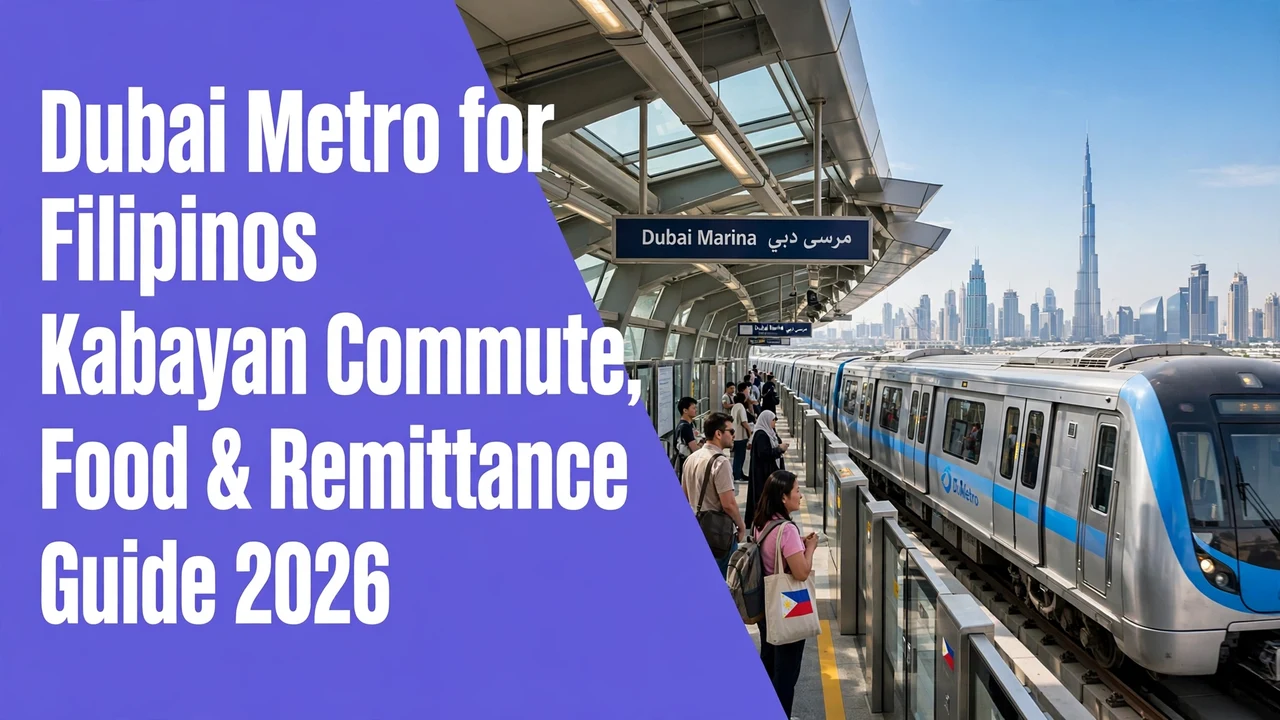
Filipinos get around Dubai on the Metro with a Silver NOL card, which costs AED 25 including AED 19 of travel credit, and a trip costs AED 3, AED 5 or AED 7.50 depending on the zones crossed. The Red Line runs from the airport through Downtown, Business Bay and the Marina, the Green Line covers Deira and Bur Dubai, and the two lines meet at Union and BurJuman. Around 450,000 Filipinos live in Dubai, from a UAE-wide community estimated at roughly 700,000. This guide covers the card, the fares, where kabayan live, the Filipino food near the stations, the remittance counters inside them, and the church run on Sundays. Facts checked 28 Nov 2026.
You do not need a car in Dubai to live well, and most Filipinos here do not own one. The Metro is clean, air conditioned and on time, and it reaches the airport, the malls, the hospitals and the offices where most kabayan work. The parts that catch newcomers are small: forgetting to tap out, boarding the wrong branch after National Paints, and turning up on a Friday morning before the trains start.
- Buy a Silver NOL card at any Metro station for AED 25, with AED 19 of credit on it.
- Tap in at the gate and tap out at the other end, every single trip.
- Karama, Satwa, Deira and International City are where most Filipinos live, and each has a Metro or bus link.
- Al Ansari Exchange has branches inside BurJuman and Al Ghubaiba Metro stations, so you can send money home on the way to work.
Start with the Dubai Metro Map to see the two lines and all 53 stations, then use the Fare Calculator to price your own trip before you travel.
What is a NOL card and which one should you buy?
A NOL card is the smart card you tap in and out with on the Metro, the Tram, RTA buses and some marine transport. You cannot pay cash at the Metro gates, so the card is the first thing to sort out. Buy the Silver card for almost every situation: it costs AED 25, of which AED 19 is travel credit, so the card itself costs only AED 6. It is anonymous, so no ID is needed, and it stays valid for 5 years. Buy one from the machines or ticket offices at any station, and top it up at the machines, at station offices, or through the nol Pay app.
Three other options exist, and each suits a different trip. The Gold card also costs AED 25 including AED 19 of credit, and it works exactly like Silver except that it opens the Gold Class cabin at the front of the train, where fares are double. The Red Ticket is a disposable paper ticket for one or two rides: it costs AED 2 plus the fare, and holds up to 10 single trips or 5 day passes. The QR ticket is the digital version of the Red Ticket, bought in the nol Pay or S’hail app, and it works on the Metro, the Tram and RTA buses only. For a newcomer who rides daily, Silver is the right buy, and it still wins for a visiting relative who stays a week and rides more than twice.
| Card or ticket | Price | Credit on it | Fare per trip | Best for |
|---|---|---|---|---|
| Silver NOL card | AED 25 | AED 19 | AED 3 to 7.50 | Daily riders and most visitors |
| Gold NOL card | AED 25 | AED 19 | AED 6 to 15 | Gold Class cabin |
| Blue NOL card | AED 70 | AED 20 | AED 1.50 to 3.75 (concession) | Students, seniors and residents who register |
| Red Ticket | AED 2 | None | AED 4 to 8.50 | One or two trips only |
| QR ticket | Free app | None | AED 6 to 10.50 | Phone only, no card |
Keep at least AED 7.50 on a Silver or Gold card, or the gates will not open. On a Blue card the minimum is AED 3.50. Top up before you travel, not at the gate with a queue behind you, and check your balance on the gate display each time you tap out. If you lose a registered Blue card, you can block it and move the balance; a lost Silver card cannot be blocked, because it is anonymous. The NOL card guide for tourists has the full comparison, and the QR tickets guide covers the phone option.
How do Metro zones and fares work?
Dubai has 7 fare zones, and your fare depends on how many zones your route touches, not on the distance or the number of stops. Metro stations sit in zones 1, 2, 5 and 6 only. A Silver card pays AED 3 for one zone, AED 5 for two zones and AED 7.50 for more than two zones, and Gold pays double on every tier. One stop can still cost a two-zone fare: Union is in Zone 5 and BurJuman is in Zone 6, so that single stop costs AED 5 on Silver.
Tap in at the start and tap out at the end, on every trip, without exception. The system reads both taps, counts the zones crossed, and deducts the matching fare. If you forget to tap out, the system charges the maximum fare on your next entry. If you change from the Metro to a bus or Tram within 30 minutes on the same NOL card, it counts as one continuous journey charged on the total zones crossed, with up to 3 transfers and a maximum journey time of 180 minutes. That rule is published by RTA, and it is what makes a Metro plus feeder bus trip cheap.
| Trip | Zones touched | Silver fare | Gold fare |
|---|---|---|---|
| Union to BurJuman (1 stop) | 2 | AED 5 | AED 10 |
| Centrepoint to Mall of the Emirates | 3 | AED 7.50 | AED 15 |
| Airport Terminal 3 to ADCB (Karama) | 2 | AED 5 | AED 10 |
| Union to Mall of the Emirates | 3 | AED 7.50 | AED 15 |
Fares checked 28 Nov 2026. Card prices are corroborated by guides citing RTA, not read directly on the RTA fares page. Price any trip exactly with the Fare Calculator.
No daily fare cap is published. RTA publishes no daily cap on its Nol Fares page, so do not plan your budget around one. Some guides online state a cap figure, but it does not appear on any rta.ae page. Budget by the trip fares in the table above, and check the gate display for the fare actually charged. Facts checked 28 Nov 2026.
What are the Metro hours and when is it crowded?
The Metro runs from 5:00 am to midnight from Monday to Thursday and on Saturday, from 5:00 am to 1:00 am on Friday, and from 8:00 am to midnight on Sunday. The Friday morning start is the one that catches newcomers: the trains do not run before 5:00 am on Friday, and on Sunday they do not start until 8:00 am. Plan around that if you have an early flight or an early shift. Check the last train for your own station in the Timings guide or the S’hail app before a late night out.
Peak hours are roughly 7:00 to 9:00 in the morning and 5:00 to 7:30 in the evening, and the Red Line through Union, BurJuman and Business Bay is packed at those times. If your shift allows it, travel 30 minutes earlier or later and you will usually get a seat. The Tram runs from 6:00 am to 1:00 am from Monday to Saturday and from 9:00 am to 1:00 am on Sunday. The rush hour guide gives the busiest times station by station.
Which cabin can you sit in, and what are the rules?
Every train has three kinds of cabin, and sitting in the wrong one can cost you a fine. The standard cabins in the middle of the train are for everyone on any card. The Gold Class cabin sits at the front, with wider seats and more space, and it needs a Gold card and a double fare. The Women and Children cabin is reserved for women and children, and men who enter it risk a fine, so check the pink floor markings and the signs before you board.
The rules are strict and the fines are real, so learn them in your first week. No eating, drinking or chewing gum anywhere past the gates, including water, and the fine is AED 100. No smoking or vaping. No sleeping across seats, and no feet on seats. The full list, with the fine for each offence, is in the Metro rules and fines guide.
Where do most Filipinos live in Dubai, and how do you get there?
Most Filipinos in Dubai live in Karama, Satwa, Deira and Bur Dubai, with a growing number in International City, and each area has its own way in by Metro or bus. Karama is the heart of it: ADCB station on the Red Line sits in the middle of the area, and BurJuman station, the Red and Green interchange, is at its northern edge. Deira is the other old centre: Al Rigga on the Red Line and Union, Salah Al Din and Baniyas Square on the Green Line serve the blocks where many kabayan live and shop, and the Gold Souq and the old markets are a short walk from Al Ras.
Satwa has no station of its own. The nearest Red Line stations are Max and ADCB, and RTA buses run into Satwa from both, so plan the bus leg before you leave. International City has no Metro yet, and it is bus country for now: routes 55 from Satwa, 53 from Gold Souq, 365 and 366 from Rashidiya Metro station, 367 from Etisalat Metro station to Dragon Mart, 50 to Business Bay, and the N30 night bus to Airport Terminal 2 all serve the area. The Blue Line, due to open on 9 September 2029, will bring three stations to International City and Dragon Mart.
| Area where Filipinos live | Nearest Metro station | Line | How to get there |
|---|---|---|---|
| Karama | ADCB, BurJuman | Red, Red and Green | Walk from either station |
| Satwa | Max, ADCB | Red | Metro to Max or ADCB, then RTA bus into Satwa |
| Deira, Al Rigga | Al Rigga, Union | Red, Red and Green | Walk from either station |
| Bur Dubai | BurJuman, Al Ghubaiba | Red and Green, Green | Walk from either station |
| International City, Dragon Mart | Rashidiya, Etisalat | Red, Green | Bus 55, 53, 365, 366 or 367 from the station |
| Oud Metha | Oud Metha | Green | Walk from the station |
If you are choosing where to live, put the Metro first: a flat beside a station beats a flat two stops closer in but a 15 minute walk away in the summer heat. The Route Planner prices the trip from any station to your workplace before you sign a lease, and the bus guide covers the feeder buses that close the last gap.
Where is the Filipino food near Metro stations?
Karama is where you eat Filipino food in Dubai. The canteens cluster around Kuwait Road, a short walk from ADCB and BurJuman stations, and a plate of silog or adobo with rice costs far less than a meal in a mall. Bulwagang Filipino on 14 D Street has served home-style cooking since 1983, and it is one of the oldest Filipino restaurants in the whole UAE. Gerry’s Grill sits on Sheikh Khalifa Bin Zayed Road across from Centrepoint, and Chowking has a Karama branch plus branches in Satwa, Al Rigga and at Financial Centre Metro station.
| Restaurant | Area | Nearest station | What to order |
|---|---|---|---|
| Bulwagang Filipino | 14 D St, Karama | ADCB, BurJuman | Sinigang, kare-kare, daing na bangus, buko pandan |
| Gerry’s Grill | Sheikh Khalifa Bin Zayed Rd, Karama | ADCB | Chicken inasal, beef sisig, crispy pata, pancit |
| Pinoy Cravings | Karama | ADCB | Chicken inasal, fried daing na bangus, palabok |
| Sendan | Al Khazna Centre, Kuwait Rd, Karama | ADCB | Filipino dishes, about AED 40 for two |
| Exotic Restaurant | Al Shaya Building, opposite Centre Point, Karama | ADCB | Tapsilog, tocilog, longsilog at AED 12 |
| Chowking | Karama, Satwa, Al Rigga | ADCB, Max, Al Rigga | Chao fan, barbecue lauriat, halo-halo |
Prices above were listed on menus and delivery pages checked 28 Nov 2026, and they change, so check the menu on the day. Deira and Satwa have Filipino canteens too, but Karama is the place to start if you are new. The things to do near Max station guide covers the streets around Karama in more detail.
Where can you send money home near a Metro station?
Sending money home is a weekly errand for most kabayan, and the easiest counters sit inside the Metro stations themselves. Al Ansari Exchange, the UAE exchange house with more than 280 branches, has a branch on the ground floor of BurJuman Metro station, Shop R40.2, and another inside Al Ghubaiba Metro station, Unit R40.6. It also has a branch at Deira City Centre Metro station and a branch in Karama at the LuLu Hypermarket on Sheikh Rashid Road, plus a branch inside BurJuman Center on Level 3.
| Exchange branch | Where it is | Nearest station |
|---|---|---|
| Al Ansari Exchange, BurJuman Metro Station | Shop R40.2, Ground Floor, inside the station | BurJuman (Red and Green) |
| Al Ansari Exchange, Al Ghubaiba Metro Station | Unit R40.6, inside the station | Al Ghubaiba (Green) |
| Al Ansari Exchange, Deira City Centre Metro Station | Inside the station | Deira City Centre (Red) |
| Al Ansari Exchange, BurJuman Center | Level 3, BurJuman Center | BurJuman (Red and Green) |
| Al Ansari Exchange, Karama | LuLu Hypermarket, Sheikh Rashid Road | ADCB (Red) |
Branch locations are from the Al Ansari Exchange branch list, checked 28 Nov 2026. The Karama LuLu branch is reported on remittance guides rather than the company’s own branch list, so check the address in the branch locator before you go. Exchange rates and fees change through the day, and no fee figure in this guide is a fixed price, so compare the rate and the fee at the counter or in the Al Ansari Exchange app before you send.
Check the rate, not just the fee. Two counters can charge the same fee and still give you a different amount in pesos, because the exchange rate matters more than the fee on a regular transfer. Compare the rate and the fee together, keep the receipt, and check the amount received matches what the counter quoted. If it does not, call the exchange house on 600 54 6000 with the receipt number. Facts checked 28 Nov 2026.
How do you get to church by Metro?
St Mary’s Catholic Church in Oud Metha is the church most Filipinos in Dubai know, and the Metro takes you almost to its door. Take the Green Line to Oud Metha station, in Zone 6, and walk about 7 minutes from the station to the church compound on Oud Metha Road. From the Red Line, change at BurJuman to the Green Line towards Creek; Oud Metha is the next stop. Sunday and Friday masses draw large crowds, and the trains through Oud Metha fill up around mass times, so travel a little early and expect a queue at the gates after the service.
Mass times change through the year and around Christmas and Holy Week, so check the church website before you go rather than relying on a time in this guide. The Philippine Overseas Labor Office, which handles OWWA and contract welfare matters, is also in Oud Metha, and the Philippine Consulate General is in Al Hamriya in Deira. Check their websites for hours and booking rules before you travel, as most services need an appointment.
What should you set up on your first day?
Do five things on arrival day and the rest of the week runs itself. First, buy a Silver NOL card at the airport station and top it up with at least AED 50. Second, install the S’hail app for routes and live timings, and nol Pay for top-ups and QR tickets. Third, install the RTA Dubai app and Careem for the taxi trips the Metro cannot cover. Fourth, buy an eSIM before you fly, from a provider such as Airalo or Holafly, so you have data the moment you land.
If you arrive at Terminal 1 or Terminal 3, the Metro is inside the airport: Airport Terminal 3 and Airport Terminal 1 stations sit on the Red Line, and the ride to ADCB in Karama costs AED 5 on Silver. If you arrive at Terminal 2, there is no Metro station there, so take the bus to the nearest station or a taxi to your flat, and budget for it. The Terminal 1 vs Terminal 3 guide covers the walk and the taxi fares for each terminal. Visa and entry questions are separate from transport: use the official UAE government portal at u.ae and the GDRFA Dubai pages for those, because this guide covers transport only and is not immigration advice.
What does a week of Metro travel cost?
A daily commute on the Metro is cheap next to a taxi. A two-zone trip costs AED 5 each way on Silver, so five working days of return trips cost AED 50. A three-zone trip costs AED 7.50 each way, so the same week costs AED 75. The 7-day pass costs AED 50 for one zone, AED 80 for two zones and AED 110 for all zones, so it only saves money if you also ride at the weekend. The 30-day pass costs AED 140, AED 230 or AED 350 by zone tier, and 22 working days of return trips at AED 7.50 each way costs AED 330, so the all-zones monthly pass only pays off if you ride on weekends too.
A taxi for the same trip costs roughly AED 25 to 40 each way for a 10 kilometre ride, so a week of taxi commuting costs around AED 250 to 400 against AED 50 to 75 on the Metro. That gap is why most kabayan ride the train and save the taxi for late nights or heavy luggage. The monthly and weekly pass guide has the full pass table.
What mistakes do Filipino newcomers make on the Metro?
Forgetting to tap out is the most expensive habit, because the system charges the maximum fare on your next entry. Tap out every time, even for a one-stop trip. Boarding the wrong branch is the second: after National Paints the Red Line splits to Expo 2020 and Life Pharmacy, so check the destination screen before you board, not just the line colour. Turning up on a Friday morning before 5:00 am or on a Sunday before 8:00 am is the third, and it strands people at closed gates. Sitting in the Women and Children cabin or the Gold Class cabin without a Gold card is the fourth. Letting your balance fall below AED 7.50 is the fifth, because the gate will not open even if your trip only costs AED 3.
- Tap out at the end of every trip, even a one-stop ride.
- Check the train destination after National Paints: Expo 2020 or Life Pharmacy.
- Do not travel before 5:00 am on Friday or before 8:00 am on Sunday.
- Stay out of the Women and Children cabin and the Gold Class cabin unless you qualify.
- Keep at least AED 7.50 on your Silver card at all times.
- Do not eat, drink or chew gum past the gates. The fine is AED 100.
Can children and students travel cheaper?
Children aged 5 and under travel free on the Metro, so a small child rides with you at no cost. Older children and students pay half fare with a Blue NOL card, which costs AED 70 including AED 20 of credit: the concession fares are AED 1.50, AED 2.50 and AED 3.75 by zone tier, and the card is registered to the child, so a lost card can be blocked and the balance moved.
There is also a newer option for students. The Dubai Student Card launched on 11 November 2026, issued by RTA with KHDA, TECOM and ISIC, and it combines a campus ID with student NOL fares and an ISIC card. It costs AED 95 plus VAT, which comes to AED 99.75 including AED 20 of credit, and the 50 percent fare discount applies to ages 5 to 23 on the Metro, Tram and Dubai buses. It is issued through participating schools in phases, so students do not apply individually, and the price and application route are reported rather than published on an RTA service page, so check with your school first. The full detail is in the student card guide.

Frequently asked questions
Do Filipinos need a special card to ride the Dubai Metro?
No. Filipinos ride with the same NOL cards as everyone else. Buy a Silver NOL card for AED 25, including AED 19 of credit, at any Metro station. It works on the Metro, the Tram and RTA buses, and a trip costs AED 3, 5 or 7.50 by zones. Keep at least AED 7.50 on the card or the gates will not open.
How much is the Metro fare from the airport to Karama?
AED 5 on a Silver card. Take the Red Line from Airport Terminal 3 or Airport Terminal 1 to ADCB station in Karama. The trip crosses two zones, so it costs the two-zone fare. From Terminal 2 there is no Metro station, so take a bus to the nearest station or a taxi to your flat.
Where is the Filipino food in Dubai?
Karama, a short walk from ADCB and BurJuman stations. Bulwagang Filipino on 14 D Street has served home-style cooking since 1983, Gerry’s Grill sits across from Centrepoint, and Exotic Restaurant lists silog plates at AED 12. Deira around Al Rigga and Satwa have Filipino canteens too, but Karama is the place to start.
Where can I send money to the Philippines near a Metro station?
Al Ansari Exchange has branches inside BurJuman Metro station and Al Ghubaiba Metro station, plus branches at Deira City Centre Metro station, in BurJuman Center and in Karama. Compare the exchange rate and the fee together before you send, because the rate matters more than the fee, and keep the receipt.
How do I get to St Mary’s Church by Metro?
Take the Green Line to Oud Metha station, then walk about 7 minutes to the church on Oud Metha Road. From the Red Line, change at BurJuman to the Green Line towards Creek, and Oud Metha is the next stop. Check the church website for mass times before you go, because they change through the year.
Can my children travel cheaper on the Metro?
Yes. Children aged 5 and under travel free. Older children and students pay half fare with a Blue NOL card, at AED 1.50, 2.50 or 3.75 by zones. The new Dubai Student Card also gives a 50 percent discount for ages 5 to 23, and it is issued through participating schools in phases, so check with your child’s school.