How is the Dubai Metro different from Singapore’s MRT?
The Dubai Metro feels familiar to a Singaporean for about ten seconds. You tap a card, you ride a clean driverless train, and the signs are in English. Then the differences start to pile up. You cannot tap your bank card at the gate. Fares work by zones, not by distance. There is a cabin only for women and children, and a man who sits in it by mistake can be fined AED 100. Sunday trains start late and Friday trains run late. Fares, hours and rules were checked 28 Nov 2026 against RTA pages and the Singapore Public Transport Council fare table.
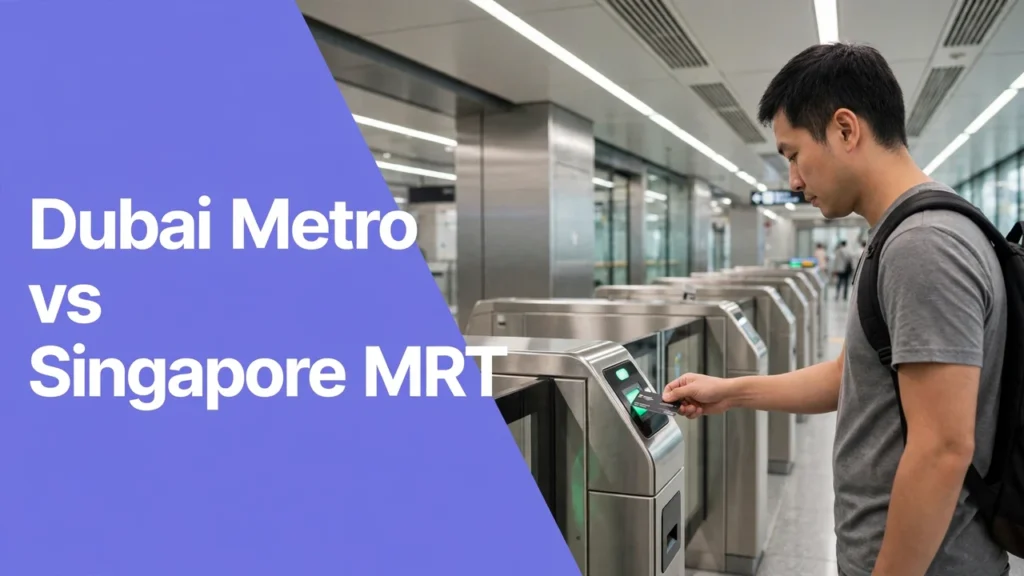
If you are flying into Dubai soon, read the payment section first. It is the difference that catches almost every Singaporean. In Singapore you tap a bank card or your phone and walk through the gate. In Dubai that does not work yet. You need a NOL card, bought at the station, before you can ride.
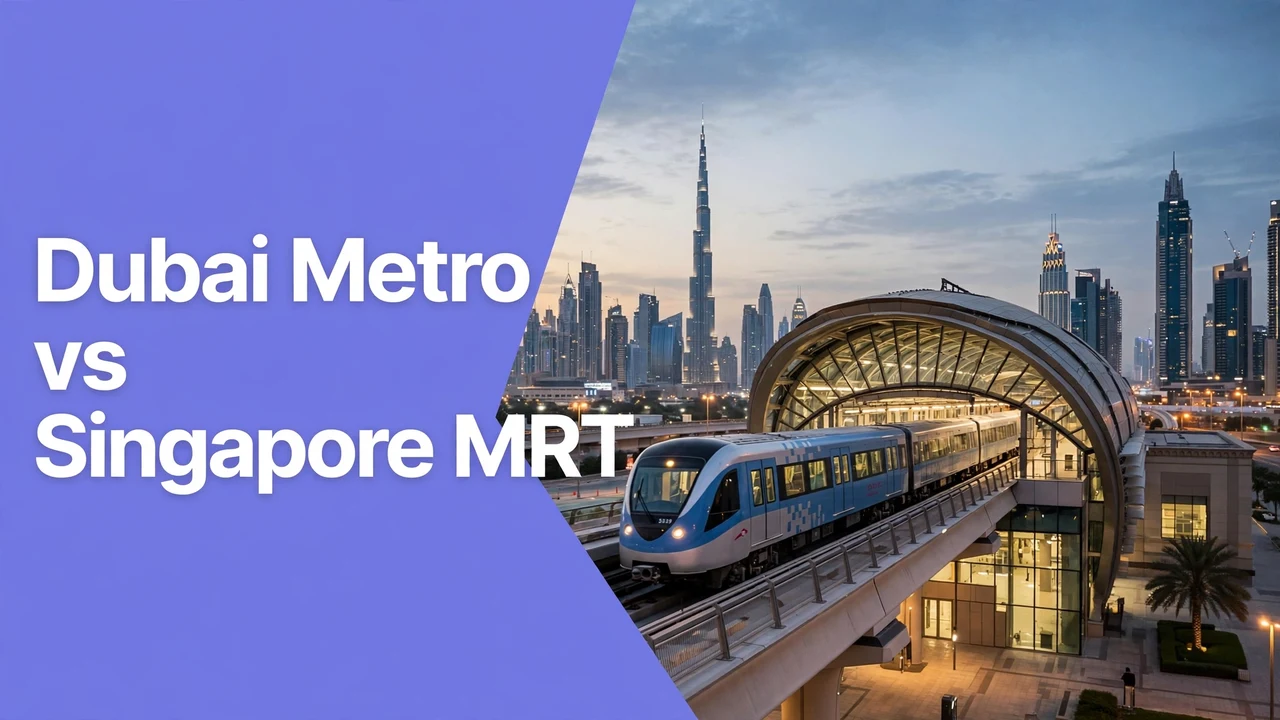
Dubai Metro vs Singapore MRT at a glance
Both networks are young, clean and heavily used, but they were built for very different cities. Singapore’s MRT covers a small island end to end. Dubai’s Metro covers one long corridor, and the rest of the city needs buses, the tram or a taxi.
| Fact | Dubai Metro | Singapore MRT |
|---|---|---|
| Opened | 9 September 2009 | 7 November 1987 |
| Lines | 2 (Red and Green) | 6 (North South, East West, North East, Circle, Downtown, Thomson-East Coast) |
| Stations | 53 distinct stations | More than 140 stations |
| Operator | RTA (Roads and Transport Authority) | SMRT Trains and SBS Transit, regulated by LTA |
| Driverless | Yes, the whole network | 4 of 6 lines (North East, Circle, Downtown, Thomson-East Coast) |
| Fare system | Zone based, 7 zones | Distance based |
| Pay at the gate | NOL card or QR ticket only | EZ-Link card, contactless bank card, or phone wallet |
| Airport link | DXB Terminals 1 and 3 on the Red Line | Changi Airport on the East West Line |
| Women and children cabin | Yes, reserved, AED 100 fine for men | No reserved cabin |
| Premium cabin | Gold Class, double the Silver fare | No premium cabin |
| Future lines | Blue Line, 14 stations, target 9 Sep 2029; Gold Line, 18 stations, target 9 Sep 2032 | Jurong Region Line from 2027; Cross Island Line in stages |
The station count is the first place other comparison guides go wrong. Dubai has 53 distinct stations, not 55: Union and BurJuman are shared by both lines, so counting them twice gives 55. Singapore has more than 140 MRT stations. Dubai’s Blue Line adds 14 stations from 2029 and the Gold Line adds 18 from 2032, but neither is open yet, so do not plan a trip around them. Read the Dubai Metro map for the network as it runs today.
How much does each one cost?
Dubai charges by zones, Singapore charges by distance. In Dubai your fare depends on how many of the city’s 7 fare zones your route touches, not on distance or stops. In Singapore your fare depends on the distance between where you tap in and where you tap out, rising in small steps from S$1.28 for a trip up to 3.2 km to S$2.57 for a trip over 40.2 km. Those are the adult card fares in force since 27 December 2025, set by the Public Transport Council. At late November 2026 rates, S$1 is about AED 2.70.
| Journey | Dubai Metro (Silver NOL) | Singapore MRT (adult card) |
|---|---|---|
| Shortest trip | AED 3 (1 zone) | S$1.28 (up to 3.2 km) |
| Medium trip | AED 5 (2 zones) | S$1.59 to S$1.75 (about 5 to 8 km) |
| Longest trip | AED 7.50 (more than 2 zones) | S$2.57 (over 40.2 km) |
| Premium cabin | Gold Class AED 6, 10 or 15 by zones | No premium cabin |
| Child | Free at 5 and under | Free under 0.9 m tall with a fare paying adult |
| Day pass | AED 22 Silver, AED 42 Gold | Singapore Tourist Pass S$17 for 1 day |
| Monthly pass | 30 day Silver AED 140, 230 or 350 by zones | Adult Monthly Travel Pass S$122 |
Two warnings belong here. First, Singapore fares rise on 26 December 2026, by 12 cents for trips up to 3.2 km and 13 cents for longer trips, so the top fare becomes S$2.70. Second, Dubai has no published daily fare cap. Several third party guides quote AED 14 a day for Silver and Blue cards and AED 28 for Gold, but that figure does not appear on the RTA Nol Fares page, so this site does not publish it as a fact. Compare the 7 day and 30 day passes on the Dubai Metro fares page instead of assuming a cap will save you money. Price any exact trip in the Dubai Metro fare calculator before you travel.
Singapore also has one discount Dubai does not. Tap in before 7.45am on a weekday and 50 cents comes off the adult fare. Dubai has no early bird discount, and its fares do not change by time of day. Dubai has a 30 minute transfer rule instead: change between Metro, bus and tram within 30 minutes and it counts as one journey, up to 3 transfers and 180 minutes in total. Singapore counts MRT and bus transfers inside 45 minutes under the same distance fare.
How do you pay: NOL card vs EZ-Link and SimplyGo
Payment is the biggest practical difference between the two systems. In Singapore you can tap a contactless Visa or Mastercard, or Apple Pay or Google Pay, at any MRT gate. SimplyGo charges the same distance fare as an EZ-Link card, and foreign Visa and Mastercard cards pay a flat S$0.60 admin fee per day of use. An EZ-Link card costs S$10, which is S$5 for the card and S$5 of stored value.
In Dubai you cannot tap a bank card at the gate. Bank card payment at Metro gates is not live, and the RTA phase that adds it is due at the end of the first quarter of 2027. Until then, every rider needs a NOL card or a QR ticket. A Silver NOL card costs AED 25 at any station machine, and it includes AED 19 of credit, so the card itself costs AED 6. It works on the Metro, the Tram, RTA buses and most water transport. A Gold NOL card costs the same AED 25 and adds Gold Class at double the Silver fare.
There is also a phone option in Dubai, but it is not the same as SimplyGo. QR tickets launched on 9 October 2026 and work as a digital Red Ticket inside the nol Pay or S’hail app. A QR single costs AED 2 more than the same Red Ticket trip, and a QR day pass costs AED 22 for regular or AED 42 for Gold. You need internet at the gate because the code refreshes in the app, and screenshots do not work. If you will ride more than once, a Silver card is cheaper than QR tickets. Read the full comparison in the Dubai Metro QR tickets guide.
Two habits from Singapore will cost you money in Dubai if you keep them. First, do not tap in with one card and tap out with another. That mistake creates two incomplete journeys charged at the maximum fare in Singapore, and Dubai works the same way. Second, keep at least AED 7.50 on a Silver or Gold card. The gates will not let you in below that balance, even for a one stop trip that costs AED 3. Check your balance before you travel, not after the gate refuses you.
Do not tap your bank card at a Dubai Metro gate. It will not work, and there is no bank card reader to try. Buy a Silver NOL card at the station machine first. It costs AED 25 with AED 19 of credit inside, and it works on the Metro, Tram and buses. Bank card tap at the gates is due at the end of the first quarter of 2027, but it is not live yet. Facts checked 28 Nov 2026.
Which network is bigger: lines, stations and coverage
Singapore’s MRT is much bigger than the Dubai Metro, and it covers its city far more completely. Six lines and more than 140 stations reach almost every part of the island. Dubai has 2 lines and 53 stations along one corridor, from Centrepoint in the east through Downtown and the Marina to Expo 2020 and Life Pharmacy in the south. The Green Line covers old Dubai, Deira and Bur Dubai. The two lines meet at Union and BurJuman, the only two interchange stations.
That gap in coverage is the honest difference between the two cities. In Singapore the MRT is the whole transport plan. In Dubai the Metro is the spine, and buses, the Tram, abras and taxis fill in the rest. Palm Jumeirah, Jumeirah Beach, the desert and many residential areas have no Metro station, so a Dubai trip usually mixes the Metro with a short taxi or a feeder bus. The Dubai Tram runs 11 stops around the Marina and JBR and connects to the Metro at DMCC station. The bus network is large and air conditioned, and the Dubai Metro bus guide covers the feeder and intercity routes.
Both networks are still growing. Dubai’s Blue Line adds 14 stations and 30 km, with a target opening of 9 September 2029, and the Gold Line adds 42 km and 18 stations with a target of 9 September 2032. Singapore’s Jurong Region Line opens from 2027, and the Cross Island Line follows in stages. The Dubai Metro Blue Line page tracks the Dubai side, and the Dubai Metro Gold Line page tracks the Gold Line.
What time do the trains run?
The hours look similar until you hit the weekend, and then they split. Dubai Metro runs Monday to Thursday and Saturday from 5am to midnight, Friday from 5am to 1am, and Sunday from 8am to midnight. Friday is the long night because it is the main weekly holiday in the UAE, and Sunday is the late start. Singapore MRT runs from about 5.15am to just after midnight every day, with first trains about 20 to 30 minutes later on Sundays and public holidays. Last trains leave the termini between about 10.45pm and 11.55pm.
Two traps catch Singaporeans in Dubai. The first is Sunday morning. In Singapore the first trains run at about 5.35am on a Sunday. In Dubai the Metro does not start until 8am on Sunday, so an early Sunday airport trip needs a taxi, not the Metro. The second is Friday. In Singapore Friday night is an ordinary night. In Dubai the Metro runs to 1am, which is genuinely useful after dinner or an event. Check the last train for your station, not just the network closing time, because only terminus last trains are published by RTA. The Dubai Metro timings page has the full table.
Frequency is close. Singapore trains run every 2 to 3 minutes at peak and every 5 to 7 minutes off peak. Dubai trains run every 3 to 7 minutes at peak and less often late at night. Both networks shut at night for maintenance, and neither runs a night service. Singapore’s old NightRider and Nite Owl night buses were discontinued and have not returned, so after the last train in either city you need a taxi or a ride hailing app.
Are both systems driverless?
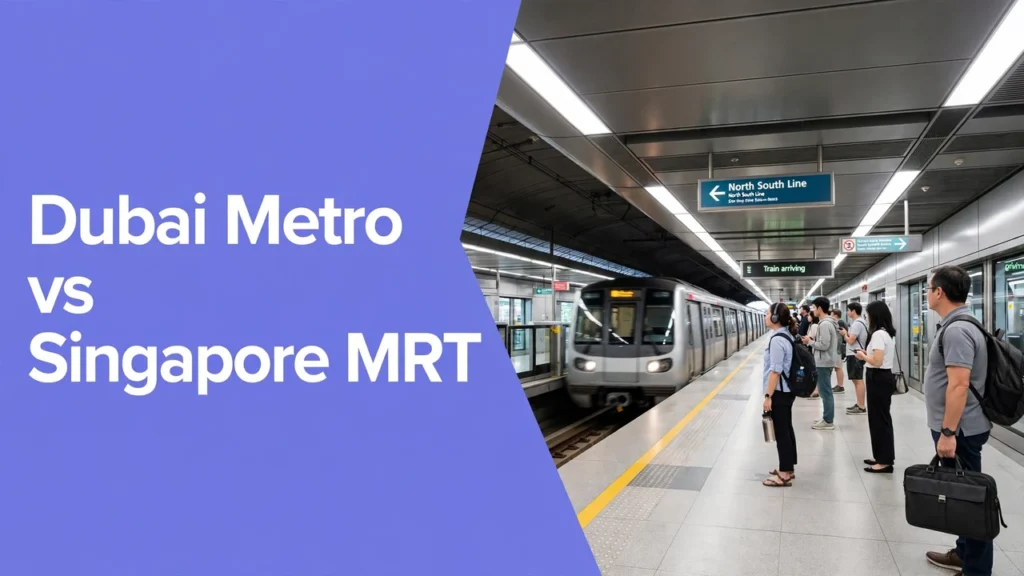
Dubai is fully driverless and Singapore is partly driverless, which is a difference of history rather than technology. Every Dubai Metro train runs without a driver, on both the Red and Green Lines. Singapore’s four newer lines run without drivers: the North East Line, which opened in 2003 as one of the world’s first fully automated heavy rail lines, plus the Circle, Downtown and Thomson-East Coast Lines. The two oldest lines, North South and East West, still run with drivers on board.
For you as a rider, the practical difference is small. Both systems are clean, air conditioned and punctual, and both use platform screen doors at underground stations. Dubai’s stations are mostly elevated along Sheikh Zayed Road, with 9 underground, so you get a view of the city from the train. If you like the front window view, ride at the front, but sit in Gold Class only if you hold a Gold card, because riding it on a Silver card is an AED 100 fine.
Which cabins can you sit in: Gold Class and the women and children cabin
This is the section Singaporeans should read twice, because Singapore has neither of these cabins and both carry fines in Dubai. Every Dubai Metro train has three kinds of cabin. Gold Class is the front cabin, with wider leather seats and a panoramic front window. It needs a Gold NOL card or a Gold Red Ticket, and Gold fares are double the Silver fare. Riding Gold Class on a Silver card is an AED 100 fine. The women and children cabin is marked in pink on the platform and on the floor, and it is reserved for women and children. A man who sits in it can be fined AED 100, even by mistake, so watch the pink floor markings in a crowded train.
Singapore has no reserved cabin and no premium cabin, and there is no fare difference between seats on the same train. That is the habit to unlearn. In Dubai, check the cabin before you sit down, not after. The Gold Class cabin is at the front of the train in one direction and the rear in the other, because the train turns at the terminus, so look at the signs on the platform doors. The women and children cabin sits next to Gold Class. Read the full cabin and fines list in the Dubai Metro rules, fines and luggage limits guide.
What are the fines: eating, drinking and smoking
Both cities fine you for eating and drinking on the train, and both include plain water. In Dubai the fines are fixed amounts from the RTA schedule: eating or drinking, including water and chewing gum, anywhere past the fare gates costs AED 100. Fare evasion costs AED 200. The fines run from AED 100 up to AED 2,000 for the most serious offences.
In Singapore the fines are court maximums set by the Rapid Transit Systems Regulations, which means the figure quoted is the ceiling, not a fixed ticket price. Eating or drinking on the MRT or LRT, including water and chewing gum, carries a maximum of S$500. Smoking carries a maximum of S$1,000. Bringing a durian on the train carries a maximum of S$500, which is the famous one. Spitting, littering or soiling carries a maximum of S$5,000. The rule has applied since the MRT opened in 1987.
| Offence | Dubai Metro fine | Singapore MRT maximum fine |
|---|---|---|
| Eating or drinking, including water | AED 100 | S$500 |
| Chewing gum | AED 100 | Covered by the S$500 eating and drinking rule |
| Smoking | AED 200 and above by offence | S$1,000 |
| Wrong cabin | AED 100 (Gold Class or women and children) | No reserved cabin |
| Fare evasion | AED 200 | Charged the maximum fare for an incomplete journey |
| Durian on the train | No specific rule | S$500 |
The practical lesson is the same in both cities: finish your food and drink before you pass the fare gates, and keep the bottle in your bag until you are outside the station. In Dubai the AED 100 fine is the fixed amount an inspector will charge. In Singapore the S$500 is the court maximum, and the amount actually imposed can be lower, but no visitor should plan around that.
Water counts as a drink in both cities. A sip from a bottle past the fare gates can cost AED 100 in Dubai and up to S$500 in Singapore. Finish your drink before you tap in, keep the bottle in your bag on the train, and drink again after you tap out. The same rule covers chewing gum. Facts checked 28 Nov 2026.
Luggage and children: what you can bring
Dubai sets a hard luggage limit and Singapore does not, which matters on airport days. In Dubai each passenger can bring a maximum of 2 bags: one large suitcase up to 81 by 58 by 30 cm and one small bag up to 55 by 38 by 20 cm. Bags must go in the luggage areas of the cabin. Two large checked suitcases per person will not fit the rule, and gate staff can turn you back to the taxi rank. Arriving with more than 2 bags per person? Take a taxi from the airport instead.
Singapore has no published two bag limit for the MRT. You are expected to keep luggage clear of aisles and doors, but there is no size table to measure against. That is more relaxed than Dubai, and it is one reason Singaporeans get caught out at DXB. Pack to the Dubai limit before you fly, not after you land. Trolleys are not allowed through the Metro gates in Dubai, so carry your bags or use the station lifts.
Children travel free in both cities, but the rule is measured differently. In Dubai, children aged 5 and under travel free on the Metro, Tram and bus, and they do not need a NOL card. In Singapore, children below 0.9 m tall travel free with a fare paying adult and need no card. A taller child under 7 travels free too, but needs a free Child Concession Card from a ticket office. If you are travelling with small children in Dubai, the women and children cabin is yours to use, and every station is step free with lifts.
Airport to city: DXB vs Changi by train
Both airports have a direct train to the city, and both are cheap, but the Dubai journey is simpler and the Singapore journey is longer. From Dubai International Airport, the Red Line serves Terminal 1 and Terminal 3 directly. The ride to Burj Khalifa and Dubai Mall station in Downtown takes about 20 minutes and costs AED 5 or AED 7.50 on a Silver card by zones. Terminal 2 has no Metro station. From Changi Airport, the East West Line branch runs from the station under Terminals 2 and 3, with a change at Tanah Merah onto a city bound train. The ride to City Hall takes about 35 to 40 minutes and costs S$2.24. Terminal 1 connects by free Skytrain to Terminals 2 and 3, and Terminal 4 by free shuttle to Terminal 2.
The late night difference matters. The last train from Changi Airport leaves at about 11.18pm, so a late arrival needs a taxi or Grab. Dubai’s Red Line runs to midnight most nights and to 1am on Friday, so check the last train from the airport station on your travel day. Neither airport charges a separate airport fare: Dubai charges the normal zone fare, and Singapore charges the normal distance fare with no airport surcharge. Read the DXB Terminal 1 vs Terminal 3 by Metro guide for the walk, the exits and the NOL card machines at each terminal.
Walking, heat and station exits: the part Singaporeans notice most
Singapore is hot and humid, and Dubai is hotter and drier, and that changes how far you should plan to walk. Singapore’s MRT stations sit close together in a compact, walkable city, and most sights are a 10 minute walk from a station at most. Dubai is spread out, and a station can be a 15 minute walk from your destination in direct sun. The Metro, the stations and the mall footbridges are fully air conditioned. The gap is the walk between the station exit and the door. In summer, walk early or after sunset, and take a short taxi for the last stretch.
Station exits need more attention in Dubai than in Singapore. Singapore stations have clear exit letters and most exits lead to a covered walkway or a mall. Dubai stations have numbered exits, and the wrong exit can put you on the wrong side of Sheikh Zayed Road. Check which exit your destination needs before you arrive, and use Google Maps to look at the walk, not just the distance. The Dubai Metro all stations page lists the stations, and the Dubai Metro route planner prices any trip. Both systems have English signage, and Dubai station staff speak English, so ask if you are unsure.
One more difference is the city around the station. Singapore’s stations open onto neighbourhoods with food, shops and covered walkways in every direction. Dubai’s stations often open onto a highway, a mall or a single district, and the area between stations can be empty. If you are used to wandering out of an MRT station and finding lunch in two minutes, give yourself more time in Dubai, and pick your station by the destination, not by the line.
Your first Dubai Metro trip, step by step
Here is the whole first trip in order. Do this once and the system will feel as easy as the MRT.
- Buy a Silver NOL card at the station machine before you go to the gate. It costs AED 25 and includes AED 19 of credit. Do not tap your bank card.
- Check your route in the S’hail app or the route planner. Note the line, the direction shown by the terminus name, and the station where you change, if you change. The only interchanges are Union and BurJuman.
- Tap in with the same NOL card you will tap out with, and keep at least AED 7.50 on it or the gate will not open.
- Check the cabin before you sit down. Gold Class needs a Gold card, and the pink marked cabin is for women and children only.
- Watch the destination display, not just the line colour. On the Red Line some trains end at National Paints and others continue to Expo 2020 or Life Pharmacy.
- Keep food, drink and gum in your bag from the moment you pass the gate.
- Tap out with the same card at your destination, then check the exit number before you leave the station.
- If you miss the last train, take Careem or a taxi. The Metro does not run all night, and neither does the MRT back home.
After one trip you will know the rhythm: buy the card, tap in, check the cabin, watch the terminus, tap out. The Dubai Metro tourist guide covers first time visitor questions, and the Dubai local transport page covers buses, the Tram, abras and taxis.
Frequently asked questions
Can I tap my bank card on the Dubai Metro like SimplyGo in Singapore?
No. Bank card tap at Dubai Metro gates is not live yet. The RTA phase that adds it is due at the end of the first quarter of 2027. Until then, buy a Silver NOL card at any station machine for AED 25, including AED 19 of credit. QR tickets in the nol Pay or S’hail app are the phone option, but they cost AED 2 more per trip than a Red Ticket.
Is the Dubai Metro cheaper than the Singapore MRT?
They are close. A short Dubai trip costs AED 3 on a Silver card and a short Singapore trip costs S$1.28, about AED 3.50. A long Dubai trip costs AED 7.50 and a long Singapore trip costs S$2.57, about AED 7. The real cost difference is coverage: the MRT reaches almost everywhere, while Dubai trips often need a taxi or bus too.
Can I eat or drink on the Dubai Metro?
No. Eating or drinking anywhere past the fare gates costs AED 100, and that includes plain water and chewing gum. Singapore has the same rule, with a maximum fine of S$500. Finish your food and drink before you tap in, and drink again after you tap out.
Which NOL card should a Singaporean visitor buy?
A Silver NOL card for almost every visitor. It costs AED 25 with AED 19 of credit, it works on the Metro, Tram and buses, and fares are AED 3, 5 or 7.50 by zones. Buy a Gold card only if you want Gold Class, which costs double the Silver fare. A Red Ticket suits a single trip.
How do I get from DXB airport to Downtown by Metro?
Take the Red Line from Airport Terminal 3 or Airport Terminal 1 station to Burj Khalifa and Dubai Mall station. The ride takes about 20 minutes and costs AED 5 or AED 7.50 on a Silver card by zones. Buy a Silver NOL card at the airport station first. Terminal 2 has no Metro station.
What time is the last train in Dubai, and what happens if I miss it?
The Metro runs to midnight Monday to Thursday and Saturday, to 1am on Friday, and to midnight on Sunday after an 8am start. Only terminus last trains are published, so check your station in the S’hail app. If you miss the last train, take Careem or a taxi, because the Metro does not run all night.