RTA Dubai Explained: What RTA Runs, Apps & Services for Metro Travellers
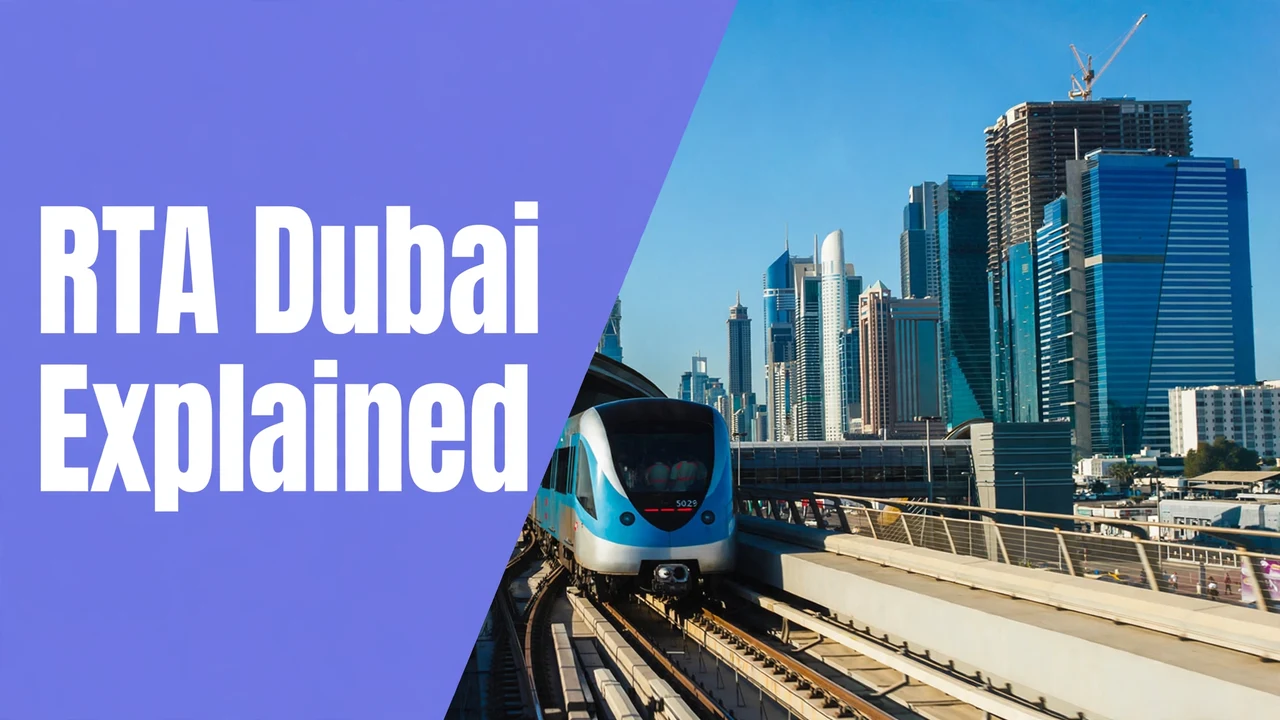
The Roads and Transport Authority, RTA for short, runs almost every way you will move around Dubai: the Metro, the Tram, the buses, the abras and ferries, the taxis and the paid parking. It also issues the NOL card and builds the apps that plan your trips and top up your card. This guide explains what RTA runs, which of its apps you actually need, and where to get help when something goes wrong. Facts were checked against rta.ae on 24 Nov 2026.
RTA Dubai Explained
RTA is the Dubai government body that runs public transport and the roads in the emirate. It sets the Metro and bus fares, runs the trains, trams, buses and boats, licenses the taxis, manages paid parking and the Salik toll gates, and issues the NOL card that pays for almost all of it. You do not deal with RTA as a company. You deal with it through its stations, its apps and its call centre, and this guide shows you which of those you need for a Metro trip.
- Metro, Tram, bus and marine transport all sit under RTA, and one NOL card pays for them.
- S’hail plans the journey. nol Pay manages the card. The RTA Dubai app is mostly for drivers.
- Fares, hours and refunds all come from RTA, so rta.ae and the S’hail app are the sources to trust.
- Stuck or overcharged? Call 800 90 90, or ask the Mahboub chatbot on rta.ae.
Start with the Local Transport guide if you want every mode in one place, or read on for what RTA is and how each piece fits together.
What RTA is and what it runs
RTA was set up in 2005 to run transport and roads in Dubai under one roof, and it still does that job today. Before RTA, buses, taxis and roads sat with different bodies. Now one authority plans the network, sets the fares, builds the stations and licenses the operators, so a Metro trip, a bus connection and a taxi home all follow the same rules and the same card. RTA sets the fares and the hours. Private firms run the trains and buses day to day under RTA contracts, which is why the staff at a station wear different uniforms but the fares and the rules are the same everywhere.
| What RTA runs | What it covers | What you use it for |
|---|---|---|
| Dubai Metro | Red and Green Lines, 53 stations | Most trips across the city |
| Dubai Tram | 11 stops around Marina and JBR | Marina, JBR and the Palm entrance |
| RTA buses | More than 100 routes, plus intercity buses | Feeder trips and places with no Metro |
| Marine transport | Abra, ferry, water taxi and water bus | Creek crossings and coastal trips |
| Taxis | Dubai Taxi Corporation and licensed firms | Door to door trips, late nights |
| Parking | Paid parking zones across Dubai | Paying for a parking bay |
| Salik | Toll gates on the main roads | Automatic tolls when you drive |
| NOL card | The smart card for public transport | Paying for Metro, Tram, bus and more |
RTA also builds the roads, the bridges and the cycling tracks, and it runs the vehicle licensing and registration system. Most of that never touches a Metro traveller, so this guide sticks to the services you will actually use: the trains, the buses, the boats, the taxis, parking and the NOL card, plus the four apps RTA publishes. The Tourist Guide covers first trips in full if you are new to all of this.
Dubai Metro: the service you will use most
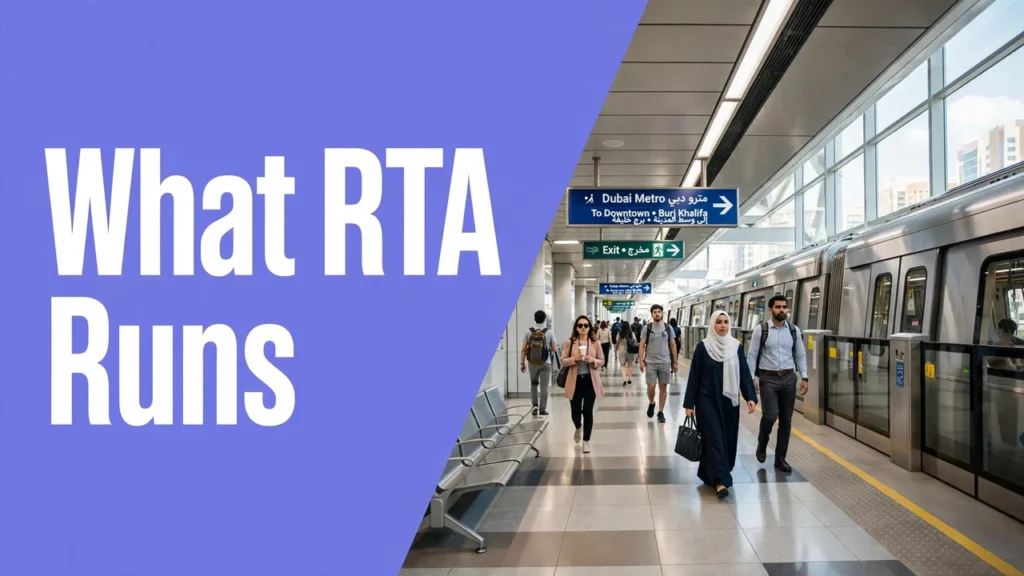
The Metro is RTA’s biggest service and the one this site is about. Two lines serve 53 distinct stations: the Red Line runs from Centrepoint in the east to the Expo 2020 and UAE Exchange ends in the west, and the Green Line runs from Etisalat by e& to Creek. Union and BurJuman are the two interchange stations where the lines meet. Trains run Monday to Thursday and Saturday from 5:00 am to midnight, Friday from 5:00 am to 1:00 am, and Sunday from 8:00 am to midnight, as checked 24 Nov 2026.
A Metro trip costs AED 3, AED 5 or AED 7.50 on a Silver NOL card, by zones crossed, and AED 6, AED 10 or AED 15 in Gold Class. You tap in at the gate and tap out at the other end, and the fare is taken from your NOL balance. Keep at least AED 7.50 on the card to get through the gates. Children aged 5 and under travel free. RTA publishes only the last trains from the terminus stations, so check the last train from your own station before a late trip. The Timings page lists the last train from every station, and the Fares page gives the full fare table.
The Metro is the fastest way across Dubai for most trips, and it is the backbone every other RTA service feeds into. Buses stop at Metro stations, the Tram meets the Red Line at two stops, and the Etihad Rail station at Al Yalayis links to Jumeirah Golf Estates station by a covered footbridge. Plan the Metro leg first, then add the bus, Tram or taxi at either end. The Route Planner works out the stops, zones and fare for any two stations.
Dubai Tram and RTA buses
The Dubai Tram runs 11 stops from Jumeirah Beach Residence 1 to Al Sufouh, along Al Sufouh Road through the Marina and JBR, and every stop sits in Zone 2. A Tram-only trip costs AED 3 on a Silver NOL card, and a Metro plus Tram trip counts as one journey when you change within 30 minutes, charged on the total zones crossed. Trams run Monday to Saturday from 6:00 am to 1:00 am and Sunday from 9:00 am to 1:00 am. Only two Tram stops connect to the Metro: Jumeirah Lakes Towers links to DMCC station, and Dubai Marina links to Sobha Realty station, both on the Red Line. The Tram guide lists all 11 stops in order.
RTA buses run more than 100 routes across Dubai, and they do the jobs the Metro cannot: feeder routes from Metro stations into neighbourhoods, direct routes to places with no station, and night buses after the Metro closes. You pay with the same NOL card, and the same zone fares apply. The buses to know are the 105 and 106 from Mall of the Emirates station to Global Village, the F55 from Expo 2020 station around Expo City, and the intercity buses to Abu Dhabi, E100, E101 and E102, which cost AED 25 each way. Buses to Sharjah run from Al Jafiliya and Union, and their fares are best checked in S’hail before you board, because RTA publishes no single fare list for them. The Bus guide covers the routes Metro travellers use most.
Marine transport: abra, ferry and water taxi
RTA runs the boats as well as the trains, and the Creek crossing by abra is the oldest public transport in Dubai. A traditional wooden abra costs AED 1 in cash and crosses the Creek in about five minutes, from Al Fahidi on the Bur Dubai side to Al Sabkha or Al Seef on the Deira side. The heritage abra route, the CR4, costs AED 2 and runs a longer loop past the old souks. Abras run from early morning until late at night, and they take cash only, so keep coins with you. The Getting Around Without a Car guide covers the abra routes in full.
The ferry is the longer boat trip, with air conditioned cabins and routes along the coast and the Creek, including Dubai Marina to Al Ghubaiba and Dubai Creek Harbour to Dubai Festival City. Ferry fares vary by route, so check the fare in S’hail or at the marine station before you board, because the RTA ferry page has shown old fares before. The water taxi is a smaller boat you book for a set route, and the water bus runs short hops around the Marina and the Creek. None of the boats takes a NOL card at the gate in the same way as the Metro, so check the payment method for your route in S’hail before you go.
Taxis, parking and Salik
RTA licenses every taxi in Dubai through the Dubai Taxi Corporation and licensed firms, and the cream coloured taxis with the coloured roofs are the ones you will see most. The flag fall is AED 5 in the day and AED 5.50 at night, the meter runs at about AED 2.19 per km, and the minimum fare is AED 12 from the street or AED 13 when booked through an app. Those per km and minimum figures come from guides, so treat them as a guide, not a promise. The airport flag is a real conflict: RTA lists AED 20 and Dubai Airports lists AED 25, so expect one of the two and check the meter when you get in. Hala, the RTA taxi service inside the Careem app, books the same licensed taxis with a fixed quote before you ride. Taxis are the fallback when the Metro has closed, and the Local Transport guide compares the taxi against the Metro, the bus and the Tram for a night out.
Paid parking is also RTA’s job. Most street parking in busy areas is paid, in zones with different hourly rates, and you pay through the RTA Dubai app, the S’hail app, the mParking SMS service or a parking meter. RTA has been moving parking payment to the apps, and cash at meters is being phased out, so paying in the app is the safest option. Salik is the toll system on the main roads, with 10 gates across Sheikh Zayed Road and other main roads. The toll is taken automatically when you drive through a gate, so as a passenger you never pay it directly, but rental cars pass Salik charges on to the driver, so check the rental terms before you drive.
NOL: the one card for all of it
The NOL card is the smart card RTA issues for public transport, and it is the one thing every Metro traveller needs. You buy a card at a Metro station ticket office or machine, top it up, and tap it at the Metro gates, the Tram validators and the bus readers. The same card also pays for parking and for some shops and services, but transport is what it is for. You can also buy a QR ticket in the S’hail or nol Pay app instead of a card, and that works as a digital Red Ticket for the Metro, the Tram and RTA buses. The QR Tickets guide covers that option in full.
| NOL card | Who it suits | What it costs to buy |
|---|---|---|
| Silver | Most visitors and residents | AED 25, including AED 19 credit |
| Gold | Gold Class Metro cabins | AED 25, including AED 19 credit |
| Blue (Personal) | Residents, students, seniors, people of determination | AED 70, including AED 20 credit |
| Red Ticket / QR ticket | One off trips, no card needed | Pay per trip, no card to buy |
| nol Travel | Tourists who want a pass plus offers | AED 100, including AED 19 credit |
Silver fares are AED 3, AED 5 or AED 7.50 by zones crossed, and Gold fares are AED 6, AED 10 or AED 15. Passes run 7, 30, 90 and 365 days: a Silver 7 day pass costs AED 50, AED 80 or AED 110 by zones, a 30 day pass AED 140, AED 230 or AED 350, a 90 day pass AED 330, AED 550 or AED 830, and a 365 day pass AED 1,060, AED 1,770 or AED 2,670, with Gold passes at double those prices. All pass prices were checked on the RTA Nol Fares page on 19 Nov 2026. Change modes within 30 minutes and RTA counts it as one journey, charged on the total zones crossed, with a maximum journey of 180 minutes and up to 3 transfers. The Pass guide compares the passes against pay as you go, and the Top Up and Refund guide covers lost cards and refunds.
There is no published daily fare cap. RTA publishes no daily cap on its Nol Fares page, so do not plan a day of travel around one. Some guides quote AED 14 or AED 20 as a cap, but neither figure appears on any rta.ae page, and the site does not state either as a fact. Budget by the zone fares, and check the Day Pass if you are making several trips: it costs AED 22 on Silver and AED 42 on Gold, and the Day Pass guide works out when it saves money.
S’hail: the journey planner app
S’hail is RTA’s all in one mobility app, and it is the app a Metro traveller will open most. It plans door to door journeys across the Metro, Tram, buses, marine transport, taxis and ride hailing, and it shows the route, the travel time and the fare before you leave. It also gives live arrival times, so you can see whether the next bus is two minutes away or twenty, and it saves your frequent searches so the daily commute takes one tap. S’hail launched in 2017, and RTA has built it into the main way it talks to travellers, with service news and disruption alerts inside the app.
S’hail does more than plan. You can top up a NOL card and buy or renew travel passes in the app, book a taxi or a limousine, open Uber or Careem to compare ride hailing fares, book an intercity bus to Abu Dhabi or Sharjah, and pay for parking. Smart rental cars from Ekar and Udrive sit in the app too. It is free on iOS, Android and Huawei phones, and it works in English and Arabic. You can use most of S’hail without an account, and you sign in with UAE Pass or an RTA account when you want to manage a NOL card or pay.
nol Pay: the card app
nol Pay is RTA’s app for the NOL card itself. It reads a physical card with your phone’s NFC reader, shows the balance and the trip history, and tops the card up in seconds with a second tap after payment. It also sells travel passes, buys QR tickets, and manages a virtual NOL card on selected phones, so the phone itself can tap at the gates on those models. Low balance reminders warn you before the card runs out at a gate. You sign in with UAE Pass or an RTA account, or continue as a guest for QR tickets. Keep the physical card with you even after topping up in the app, because you still tap the card at the gates on most phones.
The difference between the two apps is simple: S’hail plans the trip, nol Pay handles the card. S’hail can top up a card too, and nol Pay can sell a QR ticket, so they overlap, but each does its own job best. Most travellers need both on their phone, and both are free. If you only want one, take S’hail for planning and buy your NOL card at the station, then add nol Pay when you want to top up without queueing at a machine.
RTA Dubai app and Wojhati: the other two apps
The RTA Dubai app is the main RTA app, and it is aimed mostly at drivers and residents. It covers fines, Salik, vehicle licensing and renewal, parking payments and the Nol Plus rewards account, and it lets you report a transport problem or ask the Mahboub chatbot a question. For public transport it shows stops and service alerts, and it can top up a NOL card, but a Metro traveller who does not drive will use it far less than S’hail or nol Pay. Download it if you are hiring a car or paying for parking, and skip it if you are only riding the Metro.
Wojhati, which means “my destination” in Arabic, is RTA’s original journey planner, and it is still available on the web, iOS and Android. It plans trips across the Metro, Tram, buses and marine transport, with live arrival times, a fare calculator, step by step route maps and favourite journeys you can save. It does not book taxis or take payments the way S’hail does, and that is the point: Wojhati is the plain planner for people who want the route and the fare and nothing else. If S’hail feels crowded with features, Wojhati is the quieter choice, and the web version works without installing anything.
Which app do you actually need?
Four apps is too many, and most people need two. The table below picks the apps by who you are, so you can download the right ones before you land and skip the rest. All four are free, and all four work in English and Arabic.
| You are | Download | Why |
|---|---|---|
| Tourist, a few days | S’hail and nol Pay | Plan every trip, top up the card, buy QR tickets |
| Resident commuter | S’hail and nol Pay | Saved routes, live times, passes and balance alerts |
| Driving or hiring a car | RTA Dubai app as well | Fines, Salik, parking and vehicle services |
| Want the plainest planner | Wojhati instead of S’hail | Routes and fares only, no bookings or payments |
| One day, no card | S’hail only | Buy QR tickets as a guest, no NOL card needed |
Download the apps on Wi-Fi before you travel, because you need the internet to plan a trip and to buy a QR ticket, and roaming data at the airport is slow and dear. Sign in with UAE Pass if you have it, or use guest mode for QR tickets and basic planning. The apps update often, so check for updates the night before a big day out.
Getting help from RTA
When something goes wrong, RTA’s call centre is 800 90 90, and it is the number to save before you travel. It covers Metro, bus, taxi and NOL questions, and it is the route for complaints and lost property. The Mahboub chatbot on rta.ae and inside the RTA Dubai and S’hail apps answers common questions at any hour and can start a top-up or a service request. The RTA website, rta.ae, carries the full service list, including the top-up and refund services with their steps and waiting times.
In a station, ask the staff at the ticket office or the information desk. They can sell and top up NOL cards, explain a fare, and point you to the right platform. For a refund, RTA’s refund service runs through the website and the apps, and the cash refund carries a fee of 2.5 percent or AED 5, whichever is higher, while a transfer to a Personal or registered card is free. Approval takes four working days, an SMS arrives on the fifth day, and cash must be collected within 30 days. The Top Up and Refund guide gives the full steps and the six stations where cash is collected.
Mistakes visitors make with RTA services
The mistakes that cost visitors time and money with RTA are all avoidable, and they start with assuming a bank card works at the Metro gates. It does not, and the tap to pay phase is not due until the end of the first quarter of 2027. These are the five mistakes to avoid.
- Assuming a bank card taps at the gates. It does not. Buy a NOL card or a QR ticket in S’hail or nol Pay before you travel.
- Downloading only the RTA Dubai app. It is built for drivers, and a Metro traveller needs S’hail for planning and nol Pay for the card.
- Budgeting on a daily fare cap. RTA publishes no cap, so a day of short trips can cost more than you expect. Check the Day Pass instead.
- Leaving top-up to the last minute. A top-up paid online can take 45 minutes to 4 hours to activate unless you tap with NFC, so top up the night before.
- Trusting a third party guide over rta.ae. Fares, hours and refund rules change, and the RTA page is the source that counts on the day.
Avoid those five and RTA is simple: one card, two apps, and the 800 90 90 number saved in your phone. The Tourist Guide puts it all together for a first trip, and the QR Tickets guide shows how to ride without a card at all.
Frequently asked questions
What does RTA stand for?
RTA stands for the Roads and Transport Authority, the Dubai government body set up in 2005 to run transport and roads in the emirate. It runs the Metro, Tram, buses and marine transport, licenses the taxis, manages paid parking and Salik, and issues the NOL card.
Is the Dubai Metro run by RTA?
Yes. The Metro is RTA’s service: RTA owns the network, sets the fares and the hours, and licenses the firms that run the trains day to day. The same applies to the Tram and the RTA buses, so the fares and the rules are the same across all three.
Which RTA app should tourists download?
Download S’hail and nol Pay. S’hail plans journeys across Metro, Tram, bus, taxi and boat, and shows live times and fares. nol Pay manages the NOL card, tops it up, buys passes and sells QR tickets. The RTA Dubai app is mostly for drivers, and Wojhati is a plainer planner if you want routes only.
Can I pay for the Metro with a bank card?
No, not yet. Bank card tap at the Metro gates is not live, and the phase that brings it is due at the end of the first quarter of 2027. Until then you need a NOL card or a QR ticket bought in the S’hail or nol Pay app, and you tap the card or scan the QR code at the gate.
Does one NOL card work on the Metro, Tram, bus and abra?
One NOL card works on the Metro, the Tram and RTA buses, and the 30 minute transfer rule counts a change between them as one journey. The traditional abra takes cash only at AED 1, so keep coins with you for the Creek crossing, and check the payment method for ferries and water taxis in S’hail first.
How do I contact RTA for help?
Call 800 90 90 for Metro, bus, taxi and NOL questions, or ask the Mahboub chatbot on rta.ae and inside the RTA Dubai and S’hail apps. In a station, ask the staff at the ticket office or the information desk, and for refunds use the RTA refund service on the website or in the apps.