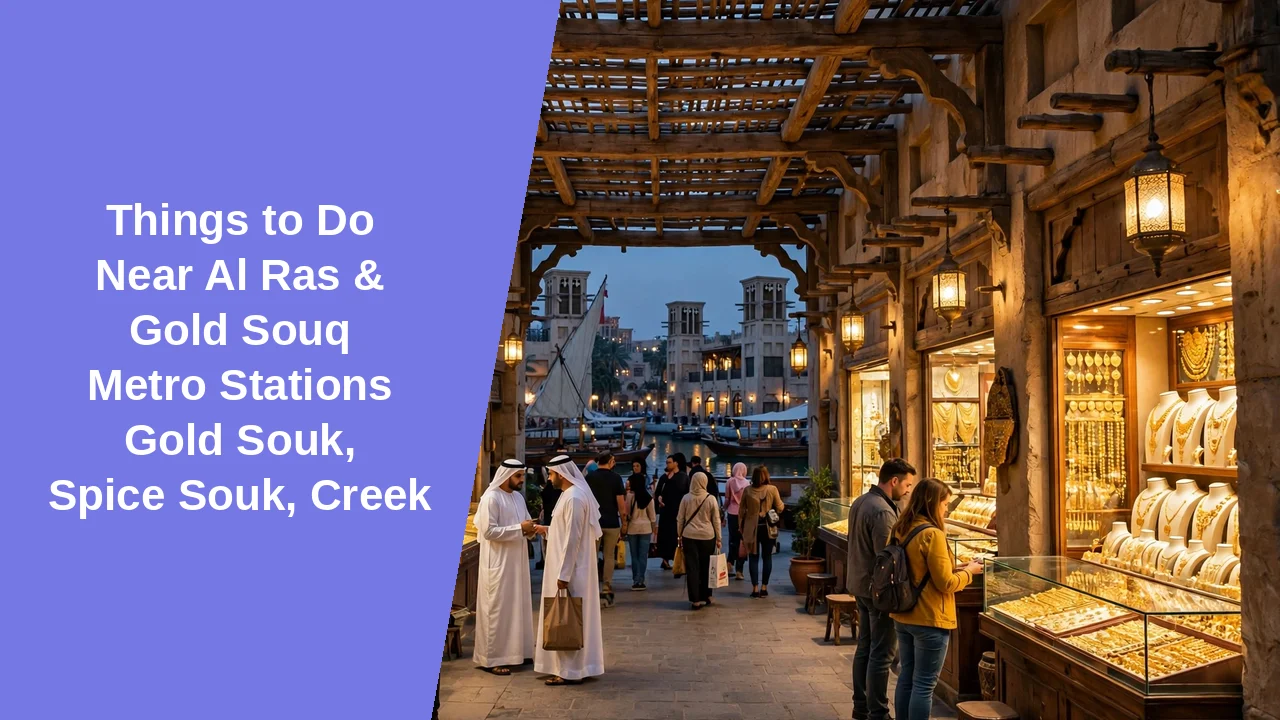
Things to Do Near Al Ras & Gold Souq Metro Stations (Gold Souk, Spice Souk, Creek)
Al Ras and Gold Souq are the two Green Line stations for the Gold Souk, the Spice Souk and Dubai Creek, and together they put the whole of Old Dubai within a short walk. Both stations sit in Zone 5, one stop apart, in the Al Ras district of Deira. From them you can browse the Gold Souk, smell your way through the Spice Souk, cross the creek by abra for AED 1, and walk the lanes of Al Seef and the Textile Souk on the Bur Dubai side. Entry to the souks is free, the creek walk costs nothing, and the whole area rewards slow walking more than any tour bus. This guide gives you the station to use for each stop, the hours to trust, a half-day route, and the costs, checked 11 Nov 2026.
Which station should you use, Al Ras or Gold Souq?
In short, use Al Ras for the Spice Souk and the creek, and Gold Souq for the Gold Souk itself. Al Ras is G23 and Gold Souq is G22, both on the Green Line in Zone 5, and the ride between them takes about two minutes. Either station works for the area as a whole, but the right choice saves you a walk back through crowded lanes in the heat. Our Al Ras Metro Station guide and our Gold Souq Metro Station guide give the station detail, and the table below gives the quick pick.
| Where you are going | Best station | Walk |
|---|---|---|
| Gold Souk | Gold Souq (G22) | About 5 minutes |
| Spice Souk and Perfume Souk | Al Ras (G23) | About 3 to 5 minutes |
| Deira Old Souq abra station | Al Ras (G23) | About 5 minutes |
| Deira Corniche and Dhow Wharfage | Al Ras (G23) | About 10 minutes |
Coming from the Red Line, change to the Green Line at Union or BurJuman and ride towards Creek. From Union it is two stops to Gold Souq and three to Al Ras. If you arrive at the wrong station, do not take the train for one stop: the walk between the two stations takes about 15 minutes along the market streets, and you will pass shops worth a look on the way. Check the exit signs at the station on the day, because exit numbers can change with station works. See the Green Line Stations page for the full line in order.
Dubai Gold Souk: what to see and how to shop
In one line, the Dubai Gold Souk is a covered market of hundreds of shops selling gold, silver, diamonds and precious stones, and it is the single best known market in Old Dubai. It sits in the Al Ras district of Deira, on the north bank of Dubai Creek, beside the Spice Souk. The lanes are covered and the windows glitter, with more than 380 retailers reported. Entry is free, and for most people the visit is the walk itself.
Most shops open about 10am to 10pm, Saturday to Thursday, and 4pm to 10pm on Friday. Many close for a midday break, roughly 1pm to 4pm. Friday morning is the worst time to come, so plan a Friday visit for the evening. Hours vary by shop and shift in Ramadan, so check on the day.
- What you will see: gold necklaces, bangles and rings, plus silver, platinum, diamonds, pearls and precious stones.
- How gold is priced: by weight at the daily rate, plus a making charge. The rate changes daily.
- What to check before you pay: the hallmark, the weight on the scale, the making charge, and the 5% VAT added at the till.
- Best time to browse: weekday evenings from 5pm, when the lanes are busy and the heat has eased.
Walk the main lanes first, then the side lanes, where the smaller shops sit. If you plan to buy, compare the making charge at three shops first: the gold rate is fixed for the day, but the making charge is the part you can bargain over. Take your time, and do not let a tout rush you into a shop.
Spice Souk and Perfume Souk: what to buy
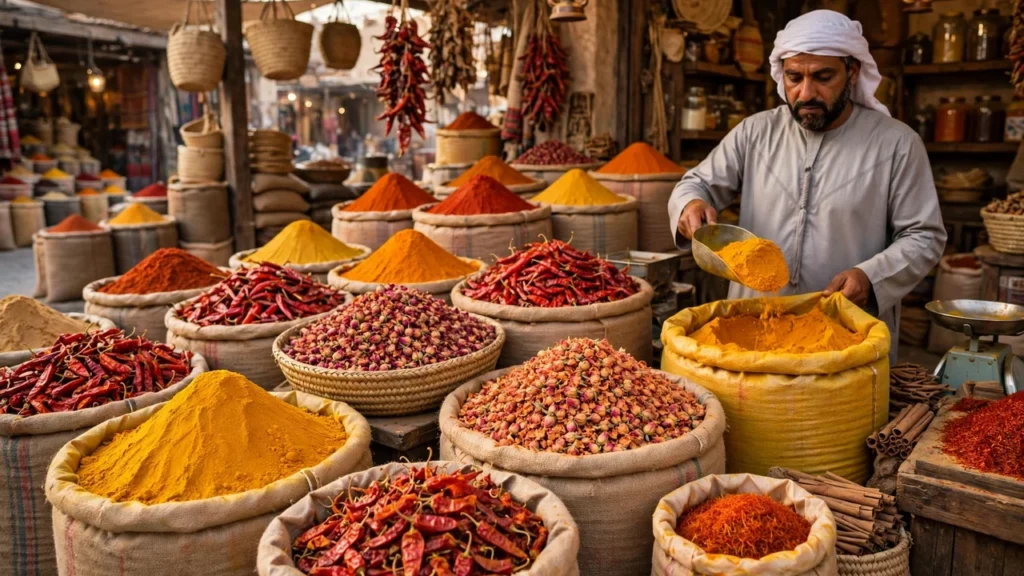
In short, the Spice Souk is a covered market of more than 150 small shops selling spices, herbs, dried fruit and nuts, and it sits right next to the Gold Souk. The air is thick with saffron, cardamom, dried roses and frankincense, and the sacks of colour make it the most photographed market in Old Dubai. It is a short walk from Al Ras station, and 30 to 45 minutes browses it properly. Entry is free, and shopkeepers expect you to look, smell and ask before you buy.
- Saffron: the famous buy, and the one to be careful with. Buy from a busy stall, ask to see the threads, and be wary of powder sold cheaply as saffron.
- Dried roses, frankincense and oud: light, easy to pack, and good small gifts.
- Dates, nuts and dried fruit: sold by weight, good to taste first, and easy to carry home.
- Spice mixes and teas: ask what each mix is for, and buy a small bag first.
The Perfume Souk sits beside the Spice Souk, selling oud, oils and attar by the bottle and by weight, with the same hours as the Gold Souk: about 10am to 10pm, Saturday to Thursday, and 4pm to 10pm on Friday, with many shops closed 1pm to 4pm. Haggling is expected, so start below the first price and settle politely. Pay in cash where you can, and keep small notes.
Dubai Creek and the AED 1 abra ride
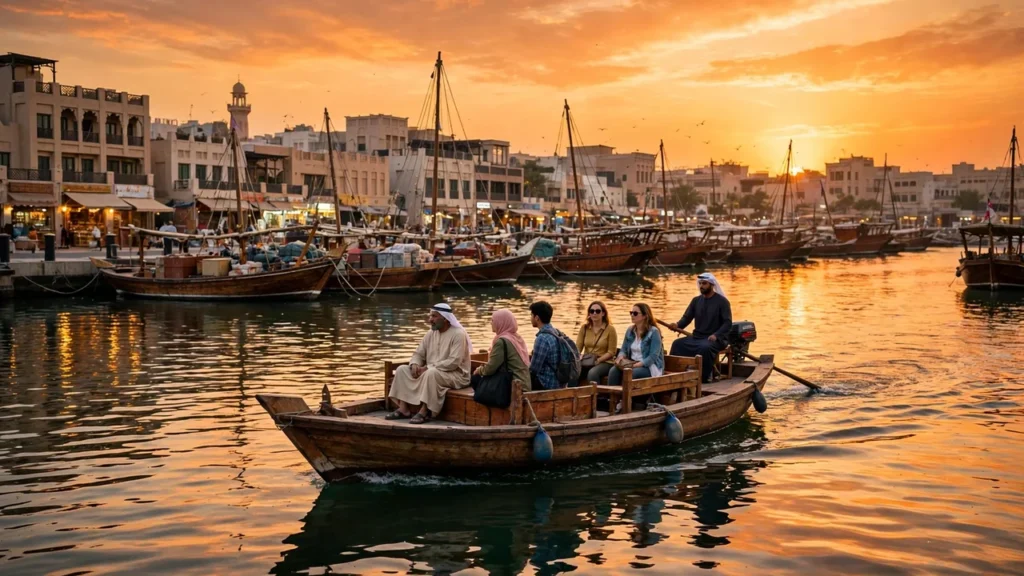
Put simply, the cheapest and best known ride on Dubai Creek is the AED 1 abra between Deira Old Souq and Bur Dubai, and it takes about five minutes. An abra is a small wooden boat carrying about 20 people, and it has worked this crossing since long before the Metro existed. The creek was the trading lifeline of the city for centuries, and dhows still load cargo along the wharf. A crossing gives you the creek view no mall can offer, for the price of a coin.
- Walk from Al Ras station to Deira Old Souq abra station, about five minutes towards the creek.
- Join the queue and pay the driver AED 1 in cash as you board, with a coin or small note ready.
- Sit down and stay seated until the boat docks.
- Step off at Bur Dubai abra station, a short walk from the Textile Souk and Al Seef.
| Route | Crossing | Fare | Hours as listed |
|---|---|---|---|
| CR1 | Bur Dubai to Deira Old Souq | AED 1, cash | 6am to midnight |
| CR2 | Dubai Old Souq to Al Sabkha | AED 1, cash | 24 hours |
Pay the abra fare in cash. The AED 1 crossing is paid to the driver as you board, so carry coins and small notes.
Other heritage abra routes use different station pairs and cost AED 2, so check the route name before you board. A private abra hire is a different product, priced before boarding, so do not assume the AED 1 fare covers it. Cross at sunset if you can: it is the best free view in Old Dubai. See our Local Transport hub for the other ways to cross the creek.
Textile Souk and Al Seef across the creek
In short, the Textile Souk and Al Seef are across Dubai Creek in Bur Dubai, one short abra ride from Deira, and they make a natural second half to the souk visit. Step off the abra and you are minutes from both. Allow an hour here, or two if you plan to eat.
Textile Souk (Old Souk)
The Textile Souk, also called the Old Souk, is a covered market of fabric shops on the Bur Dubai creekside, selling silk, cotton, pashminas, kaftans, kandoras, abayas and saris. Buy cloth by the metre or have a garment tailored, a short walk from the Bur Dubai abra station, or about 10 minutes from Sharaf DG station, formerly Al Fahidi. Usual hours are 10am to 10pm, Saturday to Thursday, and 4pm to 10pm on Friday, but sources conflict, so check on the day.
Al Seef
Al Seef is a heritage style waterfront district on the Bur Dubai side of the creek, about 1.8 km of sand coloured lanes, wind towers, small shops and creekside restaurants next to Al Fahidi. It is a rebuilt district, not an untouched old quarter. Walking the promenade is free, and it is at its best in the late afternoon and evening, when the buildings are lit. Shops usually open 10am to 10pm, Monday to Thursday, and to 11pm Friday to Sunday. The nearest Metro station is Sharaf DG, and from here you can walk south into Al Fahidi in about 10 minutes.
Deira Corniche, Dhow Wharfage and Waterfront Market
Deira Corniche is the waterfront walk north of the souks, and the Waterfront Market is its working fresh food market, so the two belong in one morning, not one stroll. The Corniche runs along the creek past the Dhow Wharfage, where wooden dhows load cargo bound for ports across the region. It is free to walk, it is quieter than the souks, and it gives you the working creek without a ticket or a queue. Go in the early morning, when the dhows are being loaded and the light is soft.
| Waterfront Market section | Hours as reported |
|---|---|
| Fish, meat and produce | 24 hours, fish closed briefly Fridays for cleaning |
| Spices and dry goods | About 6am to 1am |
| Bazaar and retail shops | 10am to 10pm, to midnight on weekends |
The Waterfront Market sits at Al Khaleej Road and Abu Hail Road, near Hamriya Port, and it replaced the old Deira Fish Market in 2017. The fish auction runs overnight, and the early morning is the liveliest time to visit. But do not walk here from the souks: the nearest Metro station, Salah Al Din, is about 4.6 km away, and Gold Souq station is no closer on foot. Take a bus or a short taxi from Gold Souq, Abu Hail or Salah Al Din instead, and treat the market as its own outing rather than a quick add-on to the souks.
Where to eat near Al Ras and Gold Souq
Put simply, the best food near Al Ras and Gold Souq is cheap, filling and close to the souks, and you never need to leave Old Dubai to eat well. This is one of the best value food areas in Dubai: small restaurants serve workers and traders, not tourists. Eat where the locals queue, and you will eat well for a few dirhams.
- By the creek in Deira: karak chai, sweet spiced tea from small cafeterias near the abra station. Order one and watch the boats.
- Lunch in Deira: Indian and Pakistani restaurants around the souks serve biryani, kebabs, curries and fresh bread.
- Creekside at Al Seef: Emirati and Arabic restaurants line the promenade, with terrace seats over the water: the stop for a slower meal at sunset.
- A sweet finish: dates and dried fruit from the Spice Souk, or a juice near the Gold Souk, make a light end to the walk.
No restaurant price is given here as a fact, because menus change, so check the menu before you order. Drink water through the day and carry a bottle between stops. For a sit-down meal, choose Al Seef; for fast and cheap, choose the cafeterias around the souks.
A half-day walking route: souks, creek and Al Seef
In short, this half-day route covers the Gold Souk, the Spice Souk, an abra crossing and Al Seef in about four to five hours, and it starts and ends at a Metro station. It runs in one direction, so you never retrace your steps. Start in the late afternoon if you can: the souks are at their liveliest, the heat has eased, and you reach Al Seef as the lights come on. Allow extra time if you plan to buy gold or fabric.
- 4:00pm, Gold Souq station: get off at Gold Souq (G22) and browse the main lanes for about an hour.
- 5:00pm, Spice Souk: walk next door to the Spice Souk and the Perfume Souk for about 45 minutes.
- 5:45pm, Deira Old Souq abra station: walk to the creek and cross by abra to Bur Dubai for AED 1 in cash.
- 6:00pm, Textile Souk: browse the fabric lanes on the Bur Dubai side for about 30 minutes.
- 6:30pm, Al Seef: walk the promenade, eat or take a karak, and watch the dhows as the light fades.
- 8:00pm, home: cross back by abra to Deira and take the Metro from Al Ras, or walk to Sharaf DG station from Al Seef.
| Stop | Time | Allow |
|---|---|---|
| Gold Souk | 4:00pm | About 1 hour |
| Spice Souk and Perfume Souk | 5:00pm | About 45 minutes |
| Abra crossing | 5:45pm | About 15 minutes |
| Textile Souk | 6:00pm | About 30 minutes |
| Al Seef | 6:30pm | About 1.5 hours |
The shorter version skips the Textile Souk and finishes in about two hours. The longer version adds a morning start, the Deira Corniche and the Waterfront Market by taxi, and that makes a full day. Either way, check the last train before you set out: our Dubai Metro Timings guide has the first and last trains.
How much does it cost? Fares, entry and spending
Put simply, entry to the souks, the creek walk and Al Seef is free, so your main costs are Metro fares, the abra and food, and the whole half-day can stay cheap. A visitor staying in central Dubai will usually cross one or two zones to reach Deira, and the table below shows what that costs on each ticket type. Fares were checked 11 Nov 2026, and they change, so check RTA on the day you travel.
| What you pay for | Cost |
|---|---|
| Metro, Silver, 1 zone | AED 3 |
| Metro, Silver, 2 zones | AED 5 |
| Metro, Silver, all zones | AED 7.50 |
| Metro, Gold, 1 / 2 / all zones | AED 6 / 10 / 15 |
| Metro, Red Ticket, 1 / 2 / all zones | AED 4 / 6 / 8.50 |
| QR single, Regular, 1 / 2 / all zones | AED 6 / 8 / 10.50 |
| QR single, Gold, 1 / 2 / all zones | AED 10 / 14 / 19 |
| QR day pass, Regular / Gold | AED 22 / 42 |
| Abra crossing, one way | AED 1, cash |
| Gold Souk, Spice Souk, Al Seef walk | Free |
Two details matter. First, the QR ticket adds an AED 2 service fee per transaction, not per ticket, so buying the day’s trips together costs one fee and buying them one at a time costs one fee each time. Second, there is no automatic daily fare cap on the RTA Nol Fares page, so do not expect your spending to stop at a fixed amount. Food is the flexible cost: a karak and a filling lunch in Deira cost a few dirhams each, while a creekside meal at Al Seef costs more. For one person the half-day is usually the Metro fare there and back, AED 1 each way on the abra, and food: often under AED 30 before shopping. Keep coins for the abra and small notes for the stalls, because many small sellers do not take cards. Use our Metro Fare Calculator to price your exact trip before you go.
Best time to visit and how long to allow
In short, the best time to visit the souks is on a weekday evening from October to April, when the air is cooler and the lanes are at their liveliest. October to April is the walking season in Dubai: open lanes, evening crowds, and a creek breeze after sunset. Go after 5pm, when the shops are open and the abra runs into the evening.
Friday needs care: most shops open at 4pm, after prayers, so a Friday morning visit finds shuttered lanes. Plan Friday for the evening. In summer, from May to September, go after sunset and keep the visit short: midday heat is hard on foot. In Ramadan the hours shift to the evening, so check nearer the time. Allow four to five hours for the full route, two for the short version, and a full day if you add the Corniche and the Waterfront Market.
Do not arrive on a Friday morning. Most souk shops open at 4pm on Friday, so a morning visit wastes the trip. Come in the evening instead.
Shopping tips: haggling, gold checks and scams to avoid
Put plainly, gold is sold by weight at the daily rate plus a making charge, and the making charge is the part you can bargain over. The daily rate is the same in every shop that day, so the only number that moves is the making charge. Compare it at three shops, settle politely, and walk away if the price does not feel right. Keep the receipt, check the hallmark, and watch the scale.
- Gold: agree the making charge before the piece is wrapped, and check the hallmark, the weight and the 5% VAT on the receipt.
- Spices: buy saffron as threads, not powder, from a busy stall, and taste dates and nuts before you buy.
- Fabric: ask the price per metre before the cloth is cut, and agree the tailoring price first.
- Touts: a friendly guide who offers his cousin’s shop is working for the shop, not for you. Smile, say no, and walk on.
- Photos: ask before you photograph a shopkeeper or a stall close up. Most will agree.
Haggling is expected in the spice, perfume and textile stalls: start below the first price, move in small steps, and settle with a smile. In the Gold Souk, haggle on the making charge, not the gold rate. Never hand over money before you have agreed the full price, and never pay for a private abra or a tour without agreeing the price first.
Getting there and getting home: Metro, bus and taxi
In short, take the Green Line to Al Ras or Gold Souq, and change at Union or BurJuman if you are coming from the Red Line, and the trip is simple from almost anywhere in Dubai. From the airport, take the Red Line from Terminal 1 or Terminal 3 to Union, then change to the Green Line towards Creek. Terminal 2 has no Metro station, so from Terminal 2 take a bus or taxi to the nearest station instead.
Bus T10 serves the Gold Souq bus station, a short walk from the souk. A taxi is the honest choice for the Waterfront Market, for a late night, or for heavy shopping: it saves a long walk in the heat. Check the last train before you travel, because the last train from Al Ras leaves before midnight on most nights, and Sunday service starts at 8am. Our Dubai Metro Timings guide and our Tourist Guide cover the first ride and the trip home.
Practical tips for a first visit
Start with this: wear comfortable shoes, carry cash in small notes, and keep water with you, because the souks are walked, not driven. The lanes are narrow and the ground is uneven in places, and you will be on your feet for hours. Dress modestly and carry a light layer for the air conditioned Metro.
- Carry cash in small notes and coins for the abra, karak and small stalls, which often do not take cards.
- Keep water with you. The souks are warm even in winter.
- Arrive after 10am, and after 4pm on a Friday, so the shops are open.
- Ask before you photograph people or goods close up, and respect a no.
- Keep your bag in front of you in the crowded lanes.
- Check your nol balance or buy a return ticket before you leave the station area.
- Check the last train before you cross to Al Seef, so you are not stranded on the wrong bank.
- Allow more time than you think: the souks reward a slow walk.
Frequently asked questions
The answers below use the same facts as the sections above, checked 11 Nov 2026.
Which metro station is closest to the Gold Souk?
Gold Souq station (G22) is the closest to the Gold Souk, about a five minute walk. Al Ras station (G23) is also close, about five minutes to the Spice Souk and the creek. Both are on the Green Line in Zone 5, one stop apart. Use Gold Souq for the Gold Souk itself, and Al Ras for the Spice Souk, the Perfume Souk and the abra station.
How much is the abra across Dubai Creek?
AED 1 per person, one way, paid in cash to the driver as you board. The CR1 route runs between Bur Dubai and Deira Old Souq, listed from 6am to midnight, and the CR2 route runs between Dubai Old Souq and Al Sabkha, listed as a 24 hour service. Other heritage abra routes cost AED 2, so check the route name before you board. A private abra hire costs more and is agreed before boarding.
Are the Gold Souk and Spice Souk free to enter?
Yes, both souks are free to enter and browse, and so is the walk at Al Seef and along Deira Corniche. You pay only for what you buy, for food and drink, and for the abra if you cross the creek. The Gold Souk has more than 380 retailers reported, and the Spice Souk has more than 150 small shops, but browsing costs nothing in either.
What time do the souks open on Friday?
Most shops open at 4pm on Friday, after prayers, and close at about 10pm. Do not arrive on a Friday morning, because the lanes will be shuttered. On other days most shops open from about 10am to 10pm, Saturday to Thursday, with many closing for a midday break around 1pm to 4pm. Hours vary by shop, so check on the day.
Can I walk from the Gold Souk to Al Seef?
Not directly, because Dubai Creek sits between them. Walk from the Gold Souk to Deira Old Souq abra station, cross by abra to Bur Dubai for AED 1 in cash, and walk from there to the Textile Souk and Al Seef. The crossing takes about five minutes, and the whole trip from the Gold Souk to Al Seef takes about 20 to 30 minutes on foot and by boat.
How long do I need for the souks and the creek?
Two hours for the short version: the Gold Souk, the Spice Souk, an abra crossing, and a short walk at Al Seef. Four to five hours for the full half-day route in this guide, including the Textile Souk and a meal at Al Seef. A full day covers the same route plus Deira Corniche and the Waterfront Market by taxi. Start in the late afternoon for the best light and the liveliest lanes.
This guide was written 2026-11-11. Hours and fares were checked the same day. See also our Green Line Stations page.