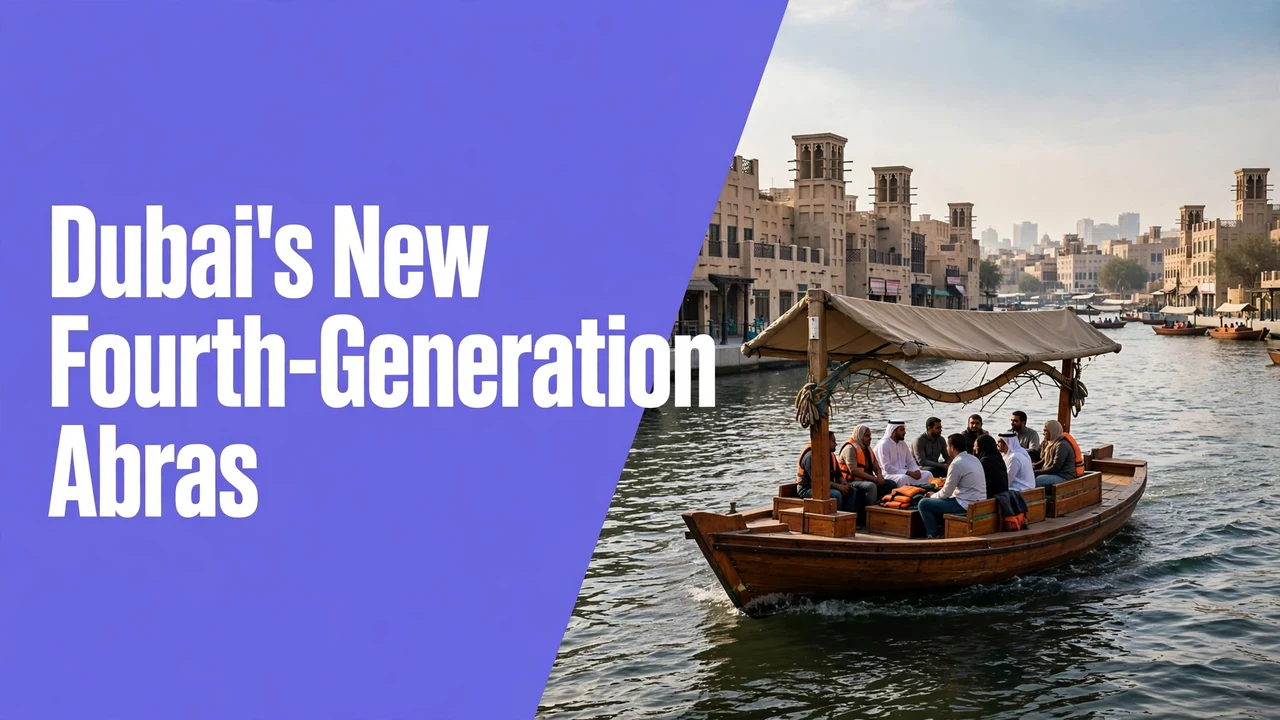
What is new about Dubai’s fourth-generation abras?
Four new fourth-generation traditional abras joined Dubai’s marine transport fleet on 6 November 2026, and they are the first abras with digital screens and electronic destination boards. Each boat carries up to 24 passengers, with upgraded seating and flooring, better use of the space inside, and designated areas for People of Determination. The fare has not changed, and the boats are traditional abras, so they join the wooden fleet on Dubai Creek rather than starting a new route. Facts were checked 28 Nov 2026.
The Roads and Transport Authority (RTA) announced the four new boats on 6 November 2026, and the news was carried the same day by the Emirates News Agency (WAM) and by Gulf News and Khaleej Times. If you ride the Creek crossing, the change is easy to spot: the new boats look like the wooden abras you know, but they carry screens inside and an electronic board showing where the boat is heading. This guide covers what is new, what it costs, which Metro station to use, and what RTA has not said yet.
- Four new boats, announced by RTA on 6 November 2026.
- Each boat carries up to 24 passengers.
- First abras with electronic destination boards, plus digital screens with real-time travel information.
- No fare change announced: the classic Creek crossing still costs AED 1 in cash.
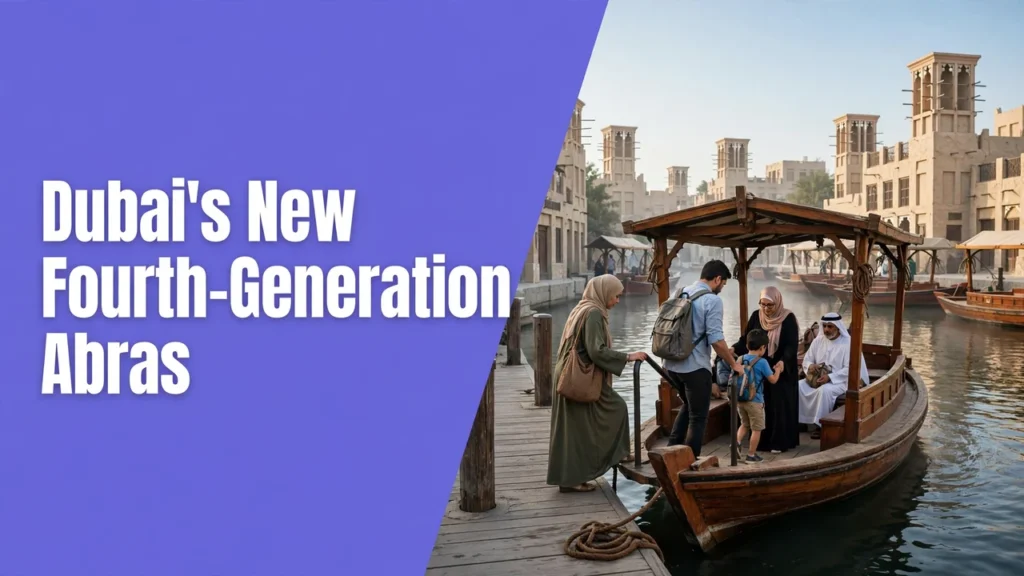
When the new abras arrived
RTA announced the four new fourth-generation traditional abras on 6 November 2026. The RTA release says the boats were built to the latest approved technical specifications and designs for this model, and the WAM report of the same day carries the same announcement. Some early reports dated the story 5 November, but the official release is dated 6 November 2026, and that is the date this guide uses.
Khalaf Belghuzooz Al Zarooni, Director of Marine Transport at RTA’s Public Transport Agency, said the addition forms part of RTA’s efforts to advance marine transport as a key component of Dubai’s sustainable mobility network. He said each new abra accommodates 24 passengers and was designed to the highest approved engineering and technical standards, in full compliance with the health and safety requirements of the Dubai Universal Design Code.
The four boats arrived three weeks after the passenger launch of Etihad Rail between Abu Dhabi and Dubai on 30 September 2026, and in the same month that RTA opened the pedestrian bridge from the Metro to Coca-Cola Arena. November 2026 has been a busy month for Dubai transport, and the abras are the smallest of the month’s arrivals, but they touch the oldest ride in the city: the wooden abra has crossed Dubai Creek for generations, and it still costs AED 1.
What is actually new on board
Five things are new on the fourth-generation abras, and all five were named in the RTA release. The table below lists each change and what it means for you on the crossing.
| What changed | What it means for you |
|---|---|
| Capacity | Up to 24 passengers per boat |
| Seating and flooring | Redesigned seats and floors, with better use of the space inside, so the boat feels roomier |
| Accessibility | Designated areas for People of Determination, built to the Dubai Universal Design Code |
| Digital screens | Real-time travel information, safety messages and awareness content during the ride |
| Destination boards | Electronic boards showing where the boat is heading, a first for this model |
| Safety and environment | Built to the latest approved technical standards, with certificates of conformity under the Gulf Standard Specifications |
The screens and the destination boards are the changes you will notice first. The older wooden abras have no screens at all: you step on, pay the boatman, and cross. On a fourth-generation boat, the screens show real-time travel information while you ride, and the destination board tells you where the boat is heading before you step on, which matters on the Creek, where several routes share the same landings.
The seating and flooring changes are quieter but they matter on a boat you ride standing or sitting on a bench in the open air. RTA says the seats and floors were redesigned and the interior space was planned better, so the boat feels roomier even though it carries up to 24 people. The boats also meet the Dubai Universal Design Code, which sets the access rules for public places and services in Dubai.
What the new abras are not
The new abras are not a new route, and they are not a fare rise. RTA announced four boats joining the existing traditional abra fleet, not a new service, and no fare change came with the announcement. The classic Creek crossing still costs AED 1 in cash, and the heritage routes along the Creek still cost AED 2 per stop.
They are also not a replacement of the whole fleet. Four boats joined a fleet that has run the Creek crossings for years, so the older wooden abras will still be on the water alongside the new ones. If you ride the crossing this week, you may get a new boat or an older one, and the fare and the route are the same either way.
And they are not a different kind of boat. The new abras are traditional abras: wooden boats with a canopy and benches along both sides, open to the air, crossing the Creek in about five minutes. They are not the petrol heritage boats that run the longer scheduled routes, and they are not ferries or water taxis. The fourth generation is an upgrade of the same wooden boat, not a new type of service.
Why RTA is upgrading the abra fleet
RTA says the new abras are part of its work to advance marine transport as a key component of Dubai’s sustainable mobility network. The authority wants the Creek crossings to feel like a proper part of the public transport network, not a leftover, and the new boats are meant to make the ride more comfortable, safer and easier to use for every passenger.
The upgrade also fits RTA’s wider push to join up the ways people move around Dubai. The same month brought the Metro to Coca-Cola Arena bridge and the Etihad Rail passenger launch, and the abras sit at the other end of that scale: a five minute crossing that links two Metro lines’ worth of souks, museums and old neighbourhoods. A better boat makes the Metro to abra to souk trip work better as one journey, and the screens and destination boards are the small piece that makes the crossing easier to read for a first-time visitor.
There is a practical side too. The Creek crossings carry residents and visitors every day, and the boats leave when full, so a clearer destination board and real-time information cut the confusion at the landings, where several routes share the same steps. RTA says the new systems let passengers access operational information clearly and easily, while boosting operating efficiency and customer satisfaction.
Which crossings will the new abras run on?
RTA has not said which crossings the four new abras will serve. The release says the boats joined the marine transport fleet, and it does not name a route. The boats are traditional abras, the type that runs the AED 1 Creek crossings, so the crossings to watch are the two classic routes: CR1 from Bur Dubai to Deira Old Souq, and CR2 from Dubai Old Souq to Al Sabkha. That is where a traditional abra works, and it is where you are most likely to see a new boat, but RTA has not confirmed it, so treat it as the likely place, not a promise.
The heritage routes are a different fleet. The longer scheduled routes along the Creek, CR3 to CR7, CR9, CR11 and BM2, run on petrol boats seating up to 20 people, and RTA has not said those boats are being replaced or upgraded. The four new boats are traditional abras, so do not expect to find them on a heritage route unless RTA says so later.
RTA has not named the routes for the four new abras. Look for them on the classic Creek crossings, CR1 and CR2, and check the destination board at the landing before you board. If the board is electronic and the boat has screens inside, you are on a fourth-generation abra.
How to spot one is simple. The new boats keep the wooden abra shape, so look inside, not at the hull: digital screens showing travel information, and an electronic destination board. The older boats have neither. If you board at Bur Dubai or Deira Old Souq and the boat has screens, you have found one of the four.
How to reach the abras by Metro
Every abra landing on the Creek sits a short walk from a Green Line station, so the Metro gets you to the boats without a taxi. The table below gives the nearest station for each landing, using the site’s abra guide, which was checked against the RTA timetable.
| Landing | Nearest Metro station | Walk |
|---|---|---|
| Bur Dubai Abra Station, for CR1 | Al Ghubaiba, Green Line, Zone 6 | About 6 minutes through the Textile Souk |
| Deira Old Souq Abra Station, for CR1 and CR2 | Al Ras, Green Line, Zone 5 | About 5 minutes |
| Al Sabkha landing, for CR2 | Sabkha, Green Line | A short walk from the station to the Creek |
| Al Fahidi landing, for heritage routes CR4 and CR5 | Al Fahidi, Green Line | A short walk to the Creek |
For the classic crossing, use Al Ghubaiba for the Bur Dubai side and Al Ras for the Deira side. The Metro fare to either station is the standard Silver fare of AED 3, AED 5 or AED 7.50, depending on how many zones you cross, and the Metro runs Monday to Thursday and Saturday from 5:00am to midnight, Friday from 5:00am to 1:00am, and Sunday from 8:00am to midnight. Use the Fare Calculator to check your fare before you set off, and the Timings page for the last train home.
Al Fahidi station is the stop for the old Dubai side of the Creek, and it is also the nearest station to Al Fahidi Fort and the Al Fahidi Historical Neighbourhood, so it works for a full morning in old Dubai: Metro to Al Fahidi, the museum and the lanes, then the abra across the Creek. See the Dubai Creek by Metro guide for the full walk, and the one-day Green Line itinerary for a day built around the Creek.
What the crossing costs
The new boats brought no fare change. The table below gives the fares from the RTA September 2026 timetable, as listed in the site’s abra guide, so you can see the whole Creek at a glance.
| Ride | Fare | Pay with |
|---|---|---|
| Classic crossing, CR1 and CR2 | AED 1 per person | Cash only, paid to the boatman |
| Heritage routes, CR3 to CR7, CR9, CR11, BM2 | AED 2 per stop | Cash, card or NOL |
| Ferry, FR1 and FR2 | AED 25 Silver, AED 35 Gold per stop | NOL |
| Water taxi | AED 7 a hop | NOL |
The classic crossing takes about five minutes, and the boats leave when full, so there is no timetable to miss. CR1 runs from about 6:00am to midnight, and guides report that CR2 runs through the night between Dubai Old Souq and Al Sabkha, so check the board at the landing if you plan a late crossing. Children under 5 ride free on the classic crossing. The heritage routes run on a schedule from about 7:00am to about 11:45pm, starting later on Sundays, and the AED 2 fare is charged per stop, so a ride that passes through a middle station counts as two stops.
No fare change was announced with the new boats. The classic Creek crossing still costs AED 1, paid in cash to the boatman, so bring coins and small notes before you reach the Creek. The heritage routes still cost AED 2 per stop, and they take cash, card or NOL.
A private traditional abra costs about AED 120 an hour, per guides, if you want the boat to yourself. That price is a guide figure, not an RTA fare, so agree it with the boatman before you board. For the full routes, hours and payment details, see the abra, ferry and water taxi guide.
What the new boats mean for People of Determination
The new abras have designated areas for People of Determination, and RTA says the boats were designed in full compliance with the health and safety requirements of the Dubai Universal Design Code. The code sets the access rules for public places and services in Dubai, and the new boats were built to meet it from the start, rather than adapted afterwards.
In practice, the change is about space and movement. The seats and floors were redesigned, the interior space was planned better, and the designated areas give passengers with different mobility needs room to board and to use the boat. The older wooden abras have benches along both sides under a canopy, and boarding them means stepping from the landing onto a boat that moves with the water, so the extra space and the clearer layout on the new boats should make the crossing easier.
RTA has not published step-by-step boarding instructions for the new boats, and it has not said whether every landing will get matching access work, so if you need step-free boarding, check with RTA or the staff at the landing on the day. The S’hail app and the RTA call centre can confirm the position at your crossing before you travel.
The screens and destination boards: what you will see
The digital screens on the new abras show real-time travel information, safety messages and awareness content. That is the first time an abra has carried screens, and it changes the feel of the ride: instead of a silent five minute crossing, the boat tells you where you are going and what to watch for on the water.
The electronic destination boards are the bigger first. They are a first for the fourth-generation model, and they solve a real problem on the Creek: several routes share the same landings, and the classic boats leave when full with no timetable, so a visitor can step onto the wrong boat. An electronic board at the landing and on the boat shows the destination clearly, and RTA says the systems let passengers access operational information clearly and easily.
Do not expect a full information system. The screens show travel information, safety messages and awareness content, and the boards show the destination. RTA has not said the screens will show live departure times for every route, or that they will carry service alerts, so treat them as a clear destination display and a safety screen, not as a live timetable. For times, the S’hail app is still the place to check.
Abra, ferry or water taxi: which crossing fits your trip
The Creek gives you four ways across the water, and the new abras only change one of them. The table below helps you pick the right boat for your trip.
| Option | Best for | Fare | How it runs |
|---|---|---|---|
| Classic abra, CR1 and CR2 | The quickest Creek crossing | AED 1 cash | About 5 minutes, leaves when full, no booking |
| Heritage abra | A longer ride along the Creek | AED 2 per stop | Scheduled, about 7:00am to 11:45pm |
| Ferry | A longer water trip, for example to Festival City or the Marina | AED 25 Silver, AED 35 Gold per stop | Two sailings a day on most legs, plan around 1:00pm and 6:00pm |
| Water taxi | Short hops in the Marina | AED 7 a hop | From about noon to late evening |
If you are crossing the Creek to reach the souks, take the classic abra. It is the cheapest ride in Dubai, the oldest, and the fastest way between the Deira souks and Al Fahidi. If you want a longer ride along the Creek to Al Fahidi, Al Seef, Festival City or Creek Harbour, take one of the heritage routes. If you want a longer water trip with a seat and a view, take the ferry, and plan around its two daily sailings. The full comparison, with every route and landing, is in the abra, ferry and water taxi guide.
What to do at the Creek after you cross
The abra is not the trip, it is the way into old Dubai, and both banks reward a slow walk. On the Bur Dubai side, Al Fahidi Fort Museum reopened on Friday 20 November 2026, with six galleries and more than 700 heritage items in the fort built in 1787. Hours and ticket prices have not been published in official sources, so check Dubai Culture before you go. The Al Fahidi Historical Neighbourhood lanes and the Textile Souk sit beside the landing, and Al Seef is a short walk along the Creek.
On the Deira side, the Gold Souk and the Spice Souk sit a short walk from the Deira Old Souq landing, and the walk from Al Ras station to the souks passes the old trading streets. See the Al Ras and Gold Souq guide for the Deira side in full, and the Dubai Creek by Metro guide for both banks in one trip.
- Al Fahidi Fort Museum: reopened 20 November 2026, six galleries, more than 700 heritage items.
- Textile Souk: a short walk from Al Ghubaiba station to the Bur Dubai landing.
- Al Seef: Creekside walk with cafes and shops, near the Al Fahidi landing.
- Gold Souk and Spice Souk: a short walk from the Deira Old Souq landing and Al Ras station.
What RTA has not said yet
Three things are still unknown, and this guide will not guess them. First, RTA has not said which crossings the four new abras will serve, so the CR1 and CR2 crossings named above are the likely place, not a confirmed fact. Second, RTA has not said whether more fourth-generation boats are coming, or whether the heritage petrol fleet will get the same screens and destination boards. Third, no new hours were announced with the boats, so the existing hours stand: CR1 from about 6:00am to midnight, and the heritage routes from about 7:00am to about 11:45pm.
Check the RTA site or the S’hail app on the day if you are heading for a specific crossing, and check the board at the landing before you board. If RTA names the routes or adds more boats, this guide will be updated, and the full abra guide carries the routes and fares in full.

Frequently asked questions
When did the new fourth-generation abras arrive?
RTA announced the four new fourth-generation traditional abras on 6 November 2026. The announcement came in an RTA release carried the same day by WAM, Gulf News and Khaleej Times. Some early reports dated the story 5 November, but the official release is dated 6 November 2026.
How many passengers does a new abra carry?
Each new abra carries up to 24 passengers. The boats were built to the latest approved technical standards, with redesigned seating and flooring and better use of the space inside. The older petrol heritage boats seat up to 20 people, so the new traditional abras carry a few more.
Which Metro station is nearest to the abras?
For the Bur Dubai side of the classic crossing, use Al Ghubaiba on the Green Line, in Zone 6, about 6 minutes walk through the Textile Souk to Bur Dubai Abra Station. For the Deira side, use Al Ras on the Green Line, in Zone 5, about 5 minutes walk to Deira Old Souq Abra Station.
How much does the abra cost?
The classic Creek crossing costs AED 1 per person, paid in cash to the boatman, and children under 5 ride free. The heritage routes along the Creek cost AED 2 per stop and take cash, card or NOL. No fare change was announced with the four new boats.
Are the new abras accessible for People of Determination?
Yes, the new abras have designated areas for People of Determination, and they were built in full compliance with the health and safety requirements of the Dubai Universal Design Code. RTA says the areas make movement and use easier. Check with RTA or the staff at the landing on the day if you need step-free boarding.
How do I know if my abra is a fourth-generation boat?
Look inside the boat, not at the hull. A fourth-generation abra has digital screens showing travel information and an electronic destination board, both a first for this model. The older wooden abras have neither. RTA has not named the routes for the four new boats, so check the board at the landing before you board.