Dubai Metro Rush Hour: Busiest Times & How to Avoid the Crowds
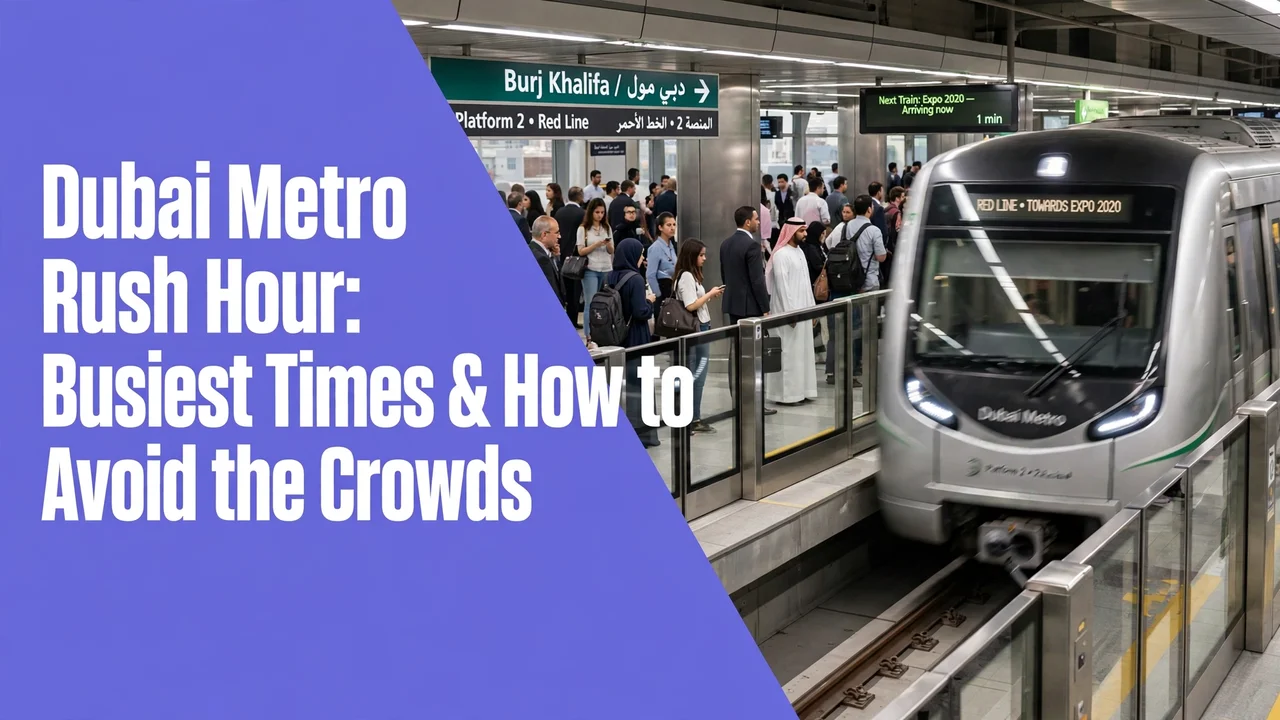
Dubai Metro rush hour runs from about 7:00 am to 9:30 am and again from about 5:00 pm to 8:00 pm on weekdays, and the crush is worst at the two interchanges, Union and BurJuman. Trains run every 3 to 4 minutes at peak, so the wait is short. The problem is the platform crowd at a handful of stations, and the crush inside the train on a few stretches of the Red Line. This guide gives the peak windows as guides report them, names the busiest stations from RTA ridership figures for the first half of 2026, and shows the tactics that work, from shifting your trip by 20 minutes to riding Gold Class. Times and fares were checked 24 Nov 2026. Treat the peak windows as typical patterns, and check the S’hail app on the day you travel.
Dubai Metro Rush Hour
Rush hour on the Dubai Metro is the weekday morning and evening commute, and you can dodge most of it by travelling 30 minutes earlier or later. The morning peak runs from about 7:00 am to 9:30 am. The evening peak runs from about 5:00 pm to 8:00 pm. Outside those windows the trains are calmer, and after 9:00 pm most trips feel quiet. The two interchanges, Union and BurJuman, stay busy longer than other stations, because every change of line passes through them. If your trip starts or ends at a quiet station, you may barely notice the peak at all.
- Travel before 7:00 am or after 9:30 am in the morning.
- Travel before 5:00 pm or after 8:00 pm in the evening.
- Let one full train go at Union or BurJuman. The next one comes in about 3 minutes.
- Ride against the flow: out of Downtown in the morning, into Downtown in the evening.
This guide works through each peak in turn, then names the busiest stations and stretches, and finishes with the tactics and the fares. See the Timings page for first and last trains from your station.

When is rush hour on the Dubai Metro
Rush hour on the Dubai Metro falls in two weekday windows, about 7:00 am to 9:30 am in the morning and about 5:00 pm to 8:00 pm in the evening. Guides do not agree to the minute. Some give 7:00 am to 9:00 am and 5:00 pm to 7:00 pm. Others stretch the morning to 9:30 am and the evening to 8:00 pm or 8:30 pm. RTA itself does not publish rush hour times. It runs extra peak services from 7:00 am to 9:00 am and from 4:00 pm to 8:00 pm, which is the closest official sign of when the network is under the most strain.
| Window | What happens | Best move |
|---|---|---|
| Morning peak, about 7:00 am to 9:30 am | Trains into Downtown, Business Bay, DIFC and the Marina fill from the suburbs and the airport | Travel before 7:00 am or after 9:30 am, or ride against the flow |
| Evening peak, about 5:00 pm to 8:00 pm | Trains out of the office districts fill towards Deira and the suburbs | Travel before 5:00 pm or after 8:00 pm, or wait for the crowd to thin |
| Sharpest morning point, about 8:00 am to 9:00 am | School and office starts overlap, and platforms are at their fullest | Shift by 20 minutes either side |
| Sharpest evening point, about 5:30 pm to 7:00 pm | Offices empty at once, and gate queues build at Business Bay | Wait until after 7:00 pm, or take a later train |
Rush hour times are typical patterns, not RTA facts. RTA publishes train times and runs extra peak services, but it publishes no rush hour timetable. The windows in this guide come from guides that report them, checked 24 Nov 2026.
The sharpest point of each peak is narrower than the full window. The worst of the morning is about 8:00 am to 9:00 am, and the worst of the evening is about 5:30 pm to 7:00 pm. Shift your trip by 20 minutes either side and the platform feels different.
Morning peak: where the crowds go
In the morning the crowds flow into the office districts, from the suburbs and the airport towards Downtown, Business Bay, DIFC and the Marina. The flow starts early. Commuters from Sharjah board at Centrepoint and Etisalat by e&, where the Park and Ride car parks fill up first. Workers from Deira and Al Qusais ride in on the Red and Green lines. Early flight passengers join at Terminal 1 and Terminal 3. By 8:00 am the trains heading towards Business Bay are full, and the platforms at Al Rigga, Union and BurJuman are at their busiest.
The direction matters more than the station. A train heading into the office districts fills at every stop from about 7:30 am. The same train heading the other way, out towards Centrepoint or Expo 2020, often has seats. If you travel against the flow in the morning, out of Downtown instead of into it, you ride in space. The Green Line is calmer, but Al Rigga, Sharaf DG and Union still fill up.
RTA added direct peak trains from Centrepoint in September 2025, to Life Pharmacy, Expo 2020 and Al Fardan Exchange, mornings 7:00 am to 9:00 am and evenings 4:00 pm to 8:00 pm. They skip stops to move the morning crowd faster.
Evening peak: the journey home
In the evening the flow reverses, and the crowds stream out of the office districts towards Deira, the suburbs and the airport. Offices empty between 5:00 pm and 6:00 pm, and the platforms at Business Bay, Financial Centre, Emirates Towers and World Trade Centre fill first. The trains heading out towards Centrepoint and Expo 2020 fill at every stop. By 6:30 pm the crush is at its worst on the Red Line, and the queues at the gates at Business Bay can stretch back into the station. The Green Line peak is lighter, but Sharaf DG and Baniyas Square still fill.
Evening travel has one advantage over the morning. The crowd leaves in a rush, then thins fast. By 8:00 pm the platforms are calm again, and by 9:00 pm most trains have seats. If you can wait, a coffee or a late dinner near your office buys you a quiet train. Check the Timings page for the last train from your station before you stay out late.
Travelling against the flow works in the evening too. A train heading into Downtown at 6:00 pm, while everyone else heads out, is often half empty. The crowds at Burj Khalifa/Dubai Mall build later, after the fountain shows, so an early evening arrival beats a late one.
The busiest stations
The busiest stations on the Dubai Metro are the two interchanges, BurJuman and Union, followed by Al Rigga, Mall of the Emirates and Business Bay on the Red Line. RTA published ridership figures for the first half of 2026, and the order is clear. BurJuman carried 8.4 million riders in six months, and Union carried 6.5 million. On the Red Line, Al Rigga carried 6.4 million, Mall of the Emirates 5.2 million and Business Bay 5 million. On the Green Line, Sharaf DG carried 4.9 million, Baniyas Square 3.8 million and Stadium 3.7 million.
| Station | Line | Riders, first half of 2026 | Why it is busy |
|---|---|---|---|
| BurJuman | Red and Green (interchange) | 8.4 million | Every line change in Bur Dubai passes through it |
| Union | Red and Green (interchange) | 6.5 million | Every line change in Deira passes through it, plus airport traffic |
| Al Rigga | Red | 6.4 million | Deira offices, hotels and bus links |
| Mall of the Emirates | Red | 5.2 million | Mall, Ski Dubai and Al Barsha offices |
| Business Bay | Red | 5.0 million | Offices, and the walk to Downtown |
| Sharaf DG | Green | 4.9 million | Bur Dubai shops and offices |
| Baniyas Square | Green | 3.8 million | Deira souks and shops |
| Stadium | Green | 3.7 million | Stadium, schools and Al Qusais homes |
These figures count all riders, not peak riders alone, so they rank the stations by total traffic, not by the worst single hour. A station can rank high on total riders and still feel calm at midday. The peak crush follows the same order, though, because the busiest stations are also the ones where commuters change lines, board from buses, or walk to offices and malls.
Two stations deserve a special note. Centrepoint and Etisalat by e& sit at the ends of the lines nearest Sharjah, and their Park and Ride car parks feed the morning peak. They rank lower on total riders than the city centre stations, but their morning platforms are among the most crowded in the network.
The two interchanges: Union and BurJuman at peak times
Union and BurJuman are the two stations where the Red and Green lines meet, and at peak times they carry the heaviest transfer crowds in the network. Every passenger who changes line passes through one of these two stations, so their platforms carry two lines of traffic at once. At 8:00 am the change from Green to Red at Union is the busiest move in the network, as Deira commuters head for the office districts. At 6:00 pm the reverse change, Red to Green, is just as busy.
Union is the harder of the two at peak. It sits in Deira, it serves the airport side of the Red Line, and its Green Line platforms sit deep underground, so the change takes longer. BurJuman is the easier change, with shorter corridors. If your trip allows either change, pick BurJuman at peak.
Allow extra time for either change at peak. A change that takes 3 minutes at midday can take 8 minutes at 8:00 am, once you count the walk, the escalator queue and the wait for a train with space. Build that time into your trip, and use the Route Planner to check the full journey before you leave.
The busiest stretches of the Red and Green lines
The busiest stretches of track are the Red Line between Centrepoint and Business Bay in the morning, and the same stretch in reverse in the evening. A stretch is busy when the trains on it fill early and stay full. In the morning the Red Line fills from Centrepoint through Al Rigga, Union and BurJuman, and it stays full past Financial Centre to Business Bay. In the evening the same stretch fills in reverse, from Business Bay back through Union to Centrepoint, and the last seats go at Financial Centre.
The Green Line has its own busy stretch, between Al Rigga and Sharaf DG in the morning, where Deira commuters ride towards Union and BurJuman. It is shorter and calmer than the Red Line stretch, and it clears faster after 9:00 am. The quietest stretch on the network is the southern end of the Red Line past DMCC towards Expo 2020, where trains run against the morning flow and often have seats all the way.
If your trip crosses the busy stretch, board one station earlier if you can, or wait for the second train. A seat matters more on a 30 minute ride than on a 5 minute hop. See the Stations page for the full list of stops on your trip.
Weekends, Ramadan and events: when the pattern changes
Weekends, Ramadan and big events change the rush hour pattern, so the weekday peaks do not tell the whole story. Saturday is the busiest weekend day. Families ride from late morning, and the malls fill from the afternoon. Burj Khalifa/Dubai Mall and Mall of the Emirates are busy from about 4:00 pm to 9:00 pm on Saturday. Sunday is calmer, with a steady flow from late morning to evening and no sharp commuter peak, because the working week starts on Monday. Friday evening brings leisure crowds too, and the Metro runs until 1:00 am, which spreads the crowd out.
Ramadan changes the pattern without changing the hours. Ramadan 2027 is expected to begin on Monday 8 February 2027, subject to the official moon sighting. The Metro kept its normal hours in Ramadan 2026, and the 2027 hours had not been announced as of 24 Nov 2026, so check rta.ae closer to the month. Working hours fall by about 2 hours a day in Ramadan, so the morning peak starts earlier and the evening peak shifts, and the malls and the Metro fill late in the evening, after iftar.
Big events break the pattern altogether. During GITEX week, World Trade Centre station is packed all day, and the evening peak stretches later. On New Year’s Eve the Metro ran non-stop for 43 hours in the last two years, from 5:00 am on 31 December to 11:59 pm on 1 January, and Burj Khalifa/Dubai Mall station closed to entry from 5:00 pm. The plan for New Year’s Eve 2026-27 had not been announced as of 24 Nov 2026, so check rta.ae in late December.
Gold Class: the quieter cabin
Gold Class is the quieter cabin at the front of every Metro train, and it costs double the Silver fare for the same trip. The cabin has wider leather seats, more legroom and fewer passengers, so it feels calmer even when the rest of the train is full. You need a Gold NOL card to ride in it, and the fare is AED 6 for 1 zone, AED 10 for 2 zones and AED 15 for 3 or more zones, against AED 3, AED 5 and AED 7.50 in Silver. A Gold QR ticket costs AED 10, AED 14 or AED 19 for a single trip. See the Fares Hub for the full fare tables, and the QR tickets guide if you ride without a NOL card.
Gold Class is not empty at rush hour. It fills up too, because commuters buy Gold cards for the same reason you would, and there is no seat guarantee. It is still the calmest cabin on the train, and on a long trip from the Marina to the airport the extra space is worth the extra fare. The women and children cabin, at the far end of the train from Gold Class, is the other quieter option.
How to avoid the crush
You can avoid most of the crush without changing your day, by shifting your trip by 20 to 30 minutes, travelling against the flow, or picking a quieter station. The tactics below all work on their own, and they work better together. Pick the two that fit your trip, and the peak feels like a different journey.
- Shift by 20 minutes. A train at 6:55 am or 9:35 am is far quieter than one at 8:15 am.
- Travel against the flow. Out of Downtown in the morning and into Downtown in the evening is the quiet direction.
- Let one full train go. The next train comes in about 3 minutes and is often half as full.
- Board one station earlier, where the train still has seats.
- Change at BurJuman, not Union, when your trip allows either change.
- Ride Gold Class on a long trip, or use the women and children cabin if it applies to you.
- Top up before you travel, so you never queue at a machine at peak.
- Check the S’hail app before you leave, and take a taxi if the app shows a delay at your station.
The cheapest tactic is the first one, and it costs nothing. Shifting by 20 minutes beats every other trick, because the peak is sharp and the trains either side of it are calm.
Rush hour fares: what a peak trip costs
A peak trip costs the same as an off-peak trip, because Dubai Metro fares depend on zones, not on the time of day. There is no peak fare and no off-peak discount on the Metro. A Silver NOL trip costs AED 3 for 1 zone, AED 5 for 2 zones and AED 7.50 for 3 or more zones, at 8:00 am and at noon. Gold Class costs double: AED 6, AED 10 and AED 15. Children aged 5 and under travel free. Fares checked 24 Nov 2026.
| Ticket | 1 zone | 2 zones | 3 or more zones |
|---|---|---|---|
| Silver NOL | AED 3 | AED 5 | AED 7.50 |
| Gold NOL (Gold Class) | AED 6 | AED 10 | AED 15 |
| Red Ticket | AED 4 | AED 6 | AED 8.50 |
| QR ticket, single | AED 6 | AED 8 | AED 10.50 |
No daily fare cap is published. RTA’s own fares page publishes no daily cap of any amount, so do not plan on one. Some guides quote AED 14 for Silver and AED 20 for Gold, but neither figure is on the RTA page. Fares checked 24 Nov 2026.
The 30-minute transfer rule still applies at peak. Tap onto a second mode within 30 minutes of tapping out, and the legs count as one journey, charged on the total zones crossed, up to 3 transfers and 180 minutes in total. The RTA Nol Fares page states that rule. A Silver card needs a minimum balance of AED 7.50 to open a gate, so top up before the peak. Use the Fare Calculator for your own trip, and see the Day Pass guide if you ride more than twice a day.
If you must travel at peak: a step-by-step plan
If you must travel at peak, plan the trip in six steps, and start with the quietest part of the journey, not the busiest. A peak trip goes wrong when one part of it is left to chance. The steps below take 5 minutes to run through, and they cover the fare, the time and the fallback.
- Check the S’hail app for live times and any delay on your line.
- Top up your NOL card before you leave, and carry a second way to pay.
- Leave 20 minutes early, or 20 minutes late, and aim for the shoulder of the peak.
- Walk to a quieter station if one is close, and board where the train still has seats.
- At Union or BurJuman, follow the signs and let one full train go.
- Know your fallback before you board: a taxi rank, a bus stop, or a later train.
If the platform is full when you arrive, do not push onto the first train. Wait for the next one, which comes in about 3 minutes, and stand near the middle of the platform, where the general cabins board. The front of the train is Gold Class, and the far end is the women and children cabin, so stand in the middle if you ride Silver. See the Tourist Guide if this is your first trip on the Metro.
Mistakes visitors make at rush hour
The mistakes visitors make at rush hour are small ones, and each one costs time, money or a missed train. None of these mistakes is hard to fix, and most visitors make one of them on their first peak trip. Read the list once, and your next peak trip runs smoother.
- Travelling at 8:15 am sharp. Shift by 20 minutes and the platform is a different place.
- Changing at Union at peak when BurJuman works for the same trip.
- Boarding at Burj Khalifa/Dubai Mall after a fountain show.
- Arriving with a low NOL balance and queueing at a machine while your train leaves.
- Standing at the front of the platform and boarding Gold Class by mistake, which carries a fine.
- Bringing big luggage at peak. Take a taxi, or ride Gold Class, and keep the aisle clear.
The fix for most of these is the same: leave earlier, check the app, and top up before you travel. If you do miss a train, the next one comes in about 3 minutes, so a missed train costs less than a rushed one.
Frequently asked questions
What time is rush hour on the Dubai Metro?
Rush hour runs from about 7:00 am to 9:30 am and from about 5:00 pm to 8:00 pm on weekdays. The sharpest points are about 8:00 am to 9:00 am and about 5:30 pm to 7:00 pm. Guides report these windows, and RTA publishes no rush hour timetable, so treat them as typical patterns. Check the live times in the S’hail app on the day you travel.
Which is the busiest Dubai Metro station?
BurJuman is the busiest station, with 8.4 million riders in the first half of 2026, ahead of Union with 6.5 million, according to RTA figures. Both are interchanges where the Red and Green lines meet, so they carry two lines of traffic at once. On the Red Line, Al Rigga is next with 6.4 million, then Mall of the Emirates with 5.2 million and Business Bay with 5 million. On the Green Line, Sharaf DG leads with 4.9 million.
Is the Dubai Metro crowded on weekends?
Yes, but in a different way. Saturday is the busiest weekend day, with families from late morning and mall crowds from about 4:00 pm to 9:00 pm at Burj Khalifa/Dubai Mall and Mall of the Emirates. Sunday is calmer, with a steady flow and no sharp commuter peak. Friday evening brings leisure crowds, and the Metro runs until 1:00 am.
Is Gold Class worth it at rush hour?
Yes, on a long trip. Gold Class is the quieter cabin at the front of every train, with wider leather seats and fewer passengers, and it costs double the Silver fare: AED 6, AED 10 or AED 15 by zone. It fills up at peak too, and there is no seat guarantee, but it is still the calmest cabin on the train. For a hop of one or two stops, save your money and ride Silver.
How often do trains run at rush hour?
Trains run every 3 to 4 minutes at peak on the Red Line, according to guides, and every 5 to 7 minutes off peak. RTA publishes no fixed headway, so use the live times in the S’hail app. The wait is rarely the problem at rush hour. The problem is finding space on the train that arrives, so let one full train go and take the next one, which is often half as full.
What is the quietest time to ride the Dubai Metro?
The quietest times are late morning, from about 9:30 am to noon, and early afternoon, from about 2:00 pm to 4:00 pm on weekdays. After 9:00 pm most trains have seats, and the last trains before closing are calm on most nights. Sunday is the calmest day of the week, with no commuter peak. Avoid 8:00 am to 9:00 am and 5:30 pm to 7:00 pm on weekdays, and avoid Burj Khalifa/Dubai Mall station after the evening fountain shows.