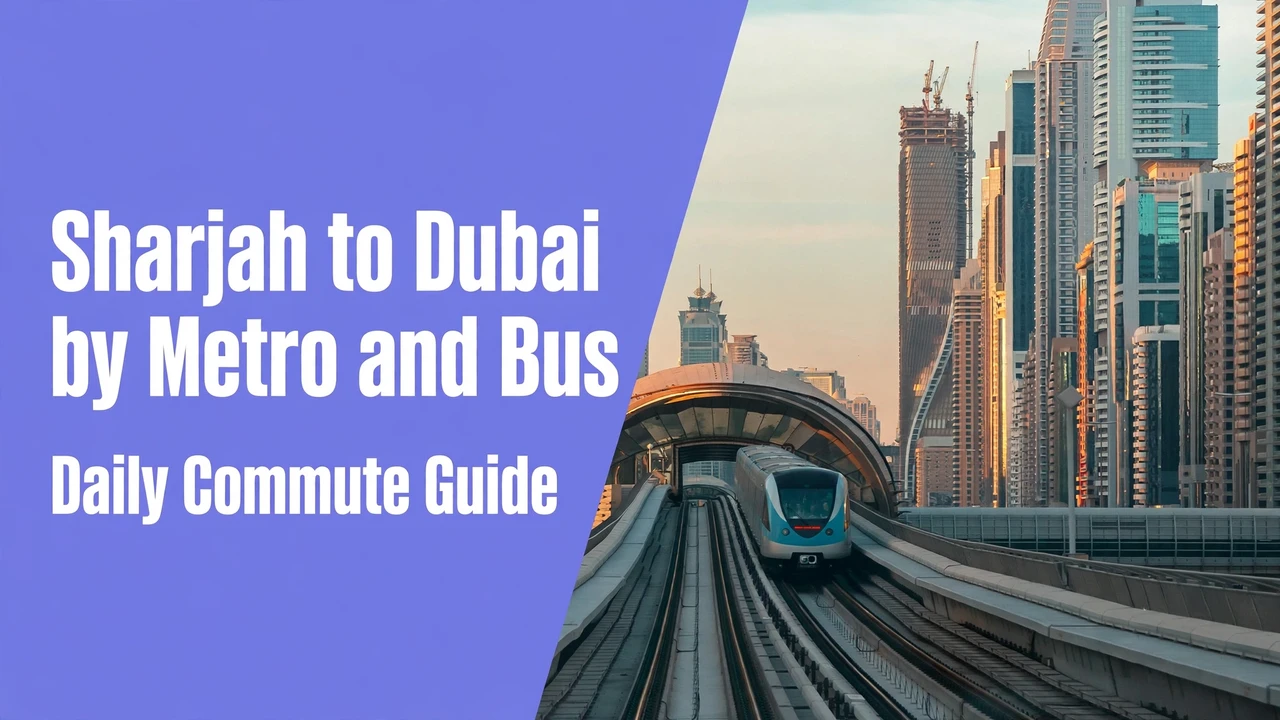
How long does the Sharjah to Dubai commute take by Metro and bus?
Door to door, the Sharjah to Dubai commute takes 1.5 to 2.5 hours each way on a weekday at peak times. The bus leg takes 50 to 90 minutes depending on traffic, and the Metro leg inside Dubai adds the rest. Off peak, the same trip can take under 90 minutes end to end. Facts checked 28 Nov 2026.
This guide is for people who live in Sharjah, work in Dubai, and ride every weekday. It covers which bus to take, where the buses stop in Dubai, how the bus connects to the Metro at Union station, what the month costs, what the same trip costs by car, and what to do when the bus is late or full. There is no Metro line into Sharjah, so the train only gets you to the bus station, and the bus does the rest.
- The bus fare is AED 12 one way on the RTA intercity buses, paid by NOL card, with no cash on board.
- Most buses leave from Al Jubail Bus Station in Sharjah and end at Union Square, Al Ghubaiba or Deira City Centre.
- The E303 bus to Union Square is the most useful for Metro commuters, because Union is the Red and Green Line interchange.
- Peak traffic runs about 6:00 to 9:30 am into Dubai and 4:30 to 8:00 pm out, with Thursday evenings the worst of the week.
The bus guide covers the feeder bus and transfer rules, and the fares page covers the Metro leg.

Which bus should you take from Sharjah to Dubai?
Take the bus that ends nearest your workplace, not the first bus that leaves Sharjah. Every RTA intercity bus from Sharjah crosses into Dubai on the same corridor, but they end at different stations, and the wrong choice adds a second Metro ride or a long walk to your day. All leave from Al Jubail Bus Station in Sharjah, except the E311 and E315, which start elsewhere. All of them are air conditioned, and all take a NOL card.
| Route | From Sharjah | Ends in Dubai | Best for | Fare | Frequency |
| E303 | Al Jubail Bus Station | Union Square, Deira | Union Metro station | AED 12 | Every 10 minutes |
| E306 | Al Jubail Bus Station | Al Ghubaiba, Bur Dubai | Bur Dubai, Al Fahidi | AED 12 | Every 30 minutes |
| E307 | Al Jubail Bus Station | Deira City Centre | Deira City Centre Metro | AED 12 | Every 15 minutes |
| E307A | Al Jubail Bus Station | Abu Hail Metro station | Abu Hail Metro | AED 12 | Every 30 minutes |
| E315 | Muwaileh Bus Station | Etisalat by e& Metro station | Muwaileh, Green Line | AED 12 | Check the S’hail app |
| E311 | Al Jubail Bus Station | Rashidiya Metro station | East Dubai, Mirdif, Al Qusais | AED 12 | Every 30 minutes |
The E303 is the default choice for most commuters, because it ends at Union Square, right above Union Metro station, and it runs every 10 minutes by day. If you work in Bur Dubai, take the E306 to Al Ghubaiba instead. If you work near Deira City Centre mall, the E307 is the shortest ride. The E311 runs the other way, from Rashidiya Metro station to Al Jubail in Sharjah, along Sheikh Mohammed bin Zayed Road, at a 30 minute headway. Use it when your Dubai end is in the east, around Rashidiya or Mirdif.
One route needs a warning. The E308, from Al Jubail to Stadium Bus Station, appears in some guides and on an RTA promotion page, but it does not appear on the RTA’s current list of operating routes, so check the S’hail app before you build a routine around it. The RTA’s own pages list different route numbers in different places, and timetables change, so the app is the check for every route in this guide.
The fare is AED 12, not AED 10. The RTA publishes AED 12 for the Sharjah intercity routes, and the current guides agree. Older guides still say AED 10, and one guide says AED 4 to 6, which is wrong. Keep at least AED 24 on your NOL card for a return trip, and top up the night before, because a declined tap at the bus door costs you the bus. Facts checked 28 Nov 2026.
Where do the Sharjah buses stop in Dubai?
The buses end at six places in Dubai. Union Square Bus Station in Deira sits above Union Metro station, the Red and Green Line interchange, and it is the best end point if you work anywhere along Sheikh Zayed Road. Al Ghubaiba Bus Station in Bur Dubai sits beside Al Ghubaiba Metro station on the Green Line, and it suits Bur Dubai, Al Fahidi and Dubai Healthcare City. Deira City Centre Bus Station sits beside Deira City Centre Metro station on the Red Line. Abu Hail Metro station is the E307A terminus, Stadium Metro station is the E308 terminus if that route runs, and Etisalat by e& Metro station is the E315 terminus.
On the Sharjah side, nearly every bus starts at Al Jubail Bus Station, a short taxi from Al Majaz Waterfront. The E315 starts at Muwaileh Bus Station instead, for Muwaileh and University City. Sharjah’s own buses also run from Rolla to Centrepoint Metro station, but those are a separate system with separate fares, covered below.
How do you get from the bus to the Metro at Union station?
Walk off the E303 at Union Square Bus Station, go down into Union Metro station, and tap in with the same NOL card. Union is the busiest interchange, where the Red Line and the Green Line cross, and the signs are in English and Arabic. The bus station is at street level and the Metro concourse is below it, so the change takes a few minutes on foot, plus the queue at the gates in the morning peak.
The Metro fare from Union depends on how many zones you cross. A Silver NOL card charges AED 3 for one zone, AED 5 for two zones and AED 7.50 for more than two zones. Union to Business Bay takes about 20 minutes, and Union to DMCC about 30 minutes. If your office is in Deira itself, you may not need the Metro at all. Check the exact time and fare for your own two stations on the Route Planner and the Fare Calculator before your first week.
Two traps catch new commuters at Union. The first is the morning gate queue: everyone from three buses arrives at once, so keep your card in your hand. The second is the Red Line split west of National Paints station, where trains divide between Expo 2020 and Life Pharmacy. Check the destination on the platform screen before you board, not just the line colour. The Union station guide covers the exits, the interchange walk and the first and last trains.
What does the Sharjah to Dubai commute cost each month?
Count the month in trips, not in days. A five day week means 44 bus trips a month, 22 each way, and at AED 12 a trip the bus alone costs about AED 528 a month. The Metro leg is extra. The table below works it out three ways. All figures use the fares checked 28 Nov 2026.
| Monthly routine | Bus (44 trips) | Metro leg | Total per month |
| Work in Deira | AED 528 | AED 0 | About AED 528 |
| 2 zones from Union, pay as you go | AED 528 | 44 x AED 5 = AED 220 | About AED 748 |
| 2 zones from Union, 30-day pass | AED 528 | AED 230 (30-day, 2 zones) | About AED 758 |
| More than 2 zones, 30-day pass | AED 528 | AED 350 (30-day, all zones) | About AED 878 |
Two things stand out. First, the bus is most of the cost, so choosing the bus that ends nearest your office matters more than saving a dirham on the train. Second, the 30-day pass only pays for itself if you also ride at weekends, because 44 pay-as-you-go trips at AED 5 cost AED 220, less than the AED 230 pass. If you ride only on working days, pay as you go. If you ride weekends too, the pass wins. The NOL pass guide has the full prices, and the day pass guide covers the AED 22 day pass for heavy travel days.
Keep a buffer on the card. The Metro gates need a minimum balance of AED 7.50 to let you in, and the bus needs the full AED 12 fare loaded, so a card with AED 10 on it gets you through neither. Top up AED 100 at a time at a station machine or in the nol Pay app, and check the balance before you leave home.
What does the same commute cost by car?
Driving is faster off peak and dearer every day. The corridor takes 25 to 45 minutes by car off peak, and 45 to 120 minutes at weekday peak, so the car saves time on a quiet Sunday and loses it on a Thursday evening. The car also pays three bills the bus never sees: Salik, fuel and parking.
| Monthly cost by car (22 working days) | Amount |
| Salik, E11, peak both ways | About AED 277 |
| Fuel, 40 km a day return | About AED 350 to 450 |
| Parking near the office | AED 0 to 600, varies by area |
| Total before car costs | About AED 630 to 1,330 |
| Bus and Metro, same month | About AED 530 to 880 |
Salik is the fixed part. Two gates, Al Mamzar North and Al Mamzar South, sit on Al Ittihad Road (E11) exactly on the Sharjah to Dubai stretch. They charge AED 6.30 per crossing at peak (6 to 10 am and 4 to 8 pm, Monday to Saturday) and AED 4.20 off peak, free between 1 am and 6 am, and AED 4.20 all day on ordinary Sundays. Crossing at peak in both directions costs about AED 12.60 a day, or about AED 277 over 22 working days. The E311 and E611 carry no Salik gates at all, so drivers on the longer road trade extra kilometres and fuel for zero tolls. Fuel is the moving part: prices change every month, so check the current month’s price, and treat the range in the table as an estimate. Parking is the wild card, because paid parking in a business district can cost more than the Salik. The Park and Ride guide covers the three Metro stations with parking, Centrepoint, National Paints and e&, for drivers who park at the Metro and ride the last leg by train.
The car only wins on time, never on money. On a normal working month the bus and Metro cost about AED 530 to 880, while the car costs about AED 630 to 1,330 before insurance, servicing and the car itself. The car earns its keep on the days the bus fails you: late nights, heavy luggage, or a meeting that runs past the last bus. For the other 20 days a month, the bus is cheaper, and you can read or rest instead of driving. Facts checked 28 Nov 2026.
What is the best time to travel to beat the traffic?
Leave Sharjah before 6:30 am, or accept the queue. The peak windows run about 6:00 to 9:30 am into Dubai and 4:30 to 8:00 pm out of it. A bus that leaves Al Jubail at 6:00 am can reach Union in about 50 minutes; the same bus at 7:30 am can take 90 minutes. Thursday evenings are the worst of the week.
Three shifts make the biggest difference. First, take the earliest bus you can stand, because the 5:30 am buses run into empty roads and the 7:30 am buses do not. Second, if your employer allows it, start work at 7:30 am and leave Dubai at 4:00 pm, which puts both legs outside the peaks. Third, ride after 8:00 pm on the return, when the outbound crawl has cleared. The rush hour guide covers the Metro peaks inside Dubai, 7:00 to 9:00 am and 5:00 to 7:30 pm, so a commuter who times the bus right still needs to time the train.
Fridays run differently. The Metro runs 5:00 am to 1:00 am on Fridays, and the buses start later than on weekdays, so check the S’hail app on a Friday instead of trusting the weekday times. Sundays start later too, with the Metro opening at 8:00 am, which matters if your working week includes a Sunday shift.
How do you pay: NOL card, Sayer card and cash
One card does not cover the whole corridor, and this is the mistake that costs new commuters a missed bus. The RTA intercity buses, the E303, E306, E307, E307A, E311 and E315, all take a NOL card, and no cash is taken on board. Tap in when you board and tap out when you get off. A Silver NOL card costs AED 25 including AED 19 of credit, and it works on the Metro, the Tram, RTA buses and the intercity buses, so it is the only card commuters need.
Sharjah’s own buses are a different system. The Sharjah Roads and Transport Authority runs the city buses inside Sharjah and the Rolla routes to Dubai, and those buses do not take a NOL card. They charge AED 15 to 20 depending on the route, for example AED 15 from Rolla to Centrepoint Metro station, and they take a Sayer card or cash. If a Sharjah city bus takes you to Al Jubail, you pay that leg separately, then you pay the RTA bus with your NOL card. Keep both cards topped up, and keep small cash for the Sharjah leg.
Register the NOL card. A registered card can be blocked and its balance moved to a new card if you lose it, and it qualifies for the monthly passes. Registration takes a few minutes on the RTA website or in the RTA Dubai app, using your Emirates ID number. The RTA guide covers the apps, including S’hail for live times and nol Pay for top-ups.
What does a working morning routine look like?
A routine that works has four steps and one buffer. Top up the NOL card the night before, so the morning never starts at a ticket machine. Reach Al Jubail Bus Station 10 minutes before the bus you want, because the morning queues are long and the buses leave full. Board, tap in, and sit near the front if you get travel sick. At Union, walk down to the Metro, tap in, and ride to your station. Add 30 minutes of buffer for your first week, and cut it back once you know the real time door to door.
- Night before: top up the NOL card to at least AED 50, and check the first bus in the S’hail app.
- Leave home: reach Al Jubail 10 minutes before your bus, and 20 minutes before it in the first week.
- On the bus: tap in at the door, tap out at Union, and keep the card in your hand.
- At Union: follow the signs to the Red Line or the Green Line, and check the destination on the platform screen.
What does the evening return look like?
The evening return is the harder leg, because everyone leaves Dubai at the same time. The outbound peak runs about 4:30 to 8:00 pm, and the buses out of Union Square, Al Ghubaiba and Deira City Centre queue in the same traffic. If you can leave the office at 4:00 pm, do it: the 4:00 pm bus is a different trip from the 5:30 pm bus. If you cannot, leave after 8:00 pm, when the roads clear.
Know your last bus. The last E303 from Union Square leaves at about 11:40 pm, the last E307 from Deira City Centre at about 12:20 am, and the last E306 from Al Ghubaiba at about 11:35 pm, with earlier last buses at weekends, so check the S’hail app before a late night. The Metro’s last trains leave the terminus stations around midnight on most nights and 1:00 am on Fridays. The Timings page has the last train times, and the rule is simple: if your meeting runs past 10:30 pm, plan the taxi home before the meeting starts.
What do you do when the bus is late or full?
Have a backup before you need one, because the corridor fails on the days you can least afford it: crashes, heavy rain, and the Thursday evening rush. The first backup is the next bus, 10 minutes away on the E303 and 15 to 30 minutes on the other routes, so a full bus usually costs you one headway, not the whole morning. The second backup is a different route: if the E303 queue at Union is too long, walk to Deira City Centre for the E307, or to Al Ghubaiba for the E306, because the three stations rarely fill at the same moment.
- Next bus: wait one headway, 10 minutes on the E303, 15 on the E307, 30 on the E306 and E307A.
- Different station: ride the Metro one or two stops and catch the E306 or E307 instead.
- Taxi share: split a taxi with colleagues, about AED 40 to 80 from Deira plus the AED 20 inter-emirate surcharge.
- Work from home: make Thursday, the worst traffic day, your home day if your employer allows it.
- Live check: the S’hail app shows live bus times, so check it before you leave the office.
Keep about AED 100 on your card or in cash for the taxi home, because the one night you need it is the night you will not want to argue about the fare. A taxi from Deira to Sharjah takes 20 to 40 minutes off peak and up to 60 minutes at rush hour, and the fare is about AED 40 to 80 plus the AED 20 surcharge for trips between Dubai and the Northern Emirates, which u.ae publishes. Careem and Uber charge more, usually about AED 100 to 150, so the street taxi is the cheaper backup.
Which areas of Sharjah work best for Metro commuters?
The best area is the one nearest a bus that goes where you work. Al Jubail itself is the hub, so flats near Al Jubail Bus Station give you every route and the shortest walk to the bus. Al Nahda and Al Taawun sit right by the border, and the buses call at Al Wahda Road, Al Safeer Mall and Ansar Mall on their way through, so you can board without going to Al Jubail. Al Majaz and Al Qasba are a short taxi from Al Jubail. Muwaileh suits the E315, which runs from Muwaileh Bus Station straight to Etisalat by e& Metro station on the Green Line. Rolla suits the Sharjah city buses to Centrepoint Metro station, which charge AED 15 and do not take a NOL card.
Two warnings before you sign a lease. First, check the walk from the flat to the bus stop in summer, because a 15 minute walk in August heat is a different commute from the same walk in January. Second, check the return leg, because some areas are easy to leave in the morning and hard to reach at night, when the bus drops you at Al Jubail and the taxi queue is long. Visit the area at 7:00 am and 7:00 pm before you decide, and ride the actual bus once.
What changes in 2027: Etihad Rail Sharjah station
A Sharjah station for Etihad Rail is scheduled to open on 30 March 2027 at University City, according to reports. The train would run from Sharjah to the Etihad Rail station in Dubai, at Al Yalayis beside Jumeirah Golf Estates Metro station, and from there the Metro would take you into the city. No timetable, no fare and no frequency has been published yet, so do not plan a move or a job around it. The Etihad Rail stations guide tracks the openings, and this page will be updated when the details are published.
The Blue Line does not help Sharjah commuters either. It opens in 2029 and serves International City, Dubai Silicon Oasis, Dubai Festival City and Dubai Creek Harbour, all inside Dubai. Until the rail station opens, the bus and the Metro are the commute, and the routine in this guide is the one to build your week around.

Frequently asked questions
Is there a Metro from Sharjah to Dubai?
No. There is no Metro line into Sharjah. The commute is a bus from Sharjah to a Dubai bus station, then the Metro from there. The E303 ends at Union Square, above Union Metro station, the Red and Green Line interchange. A rail station for Sharjah is scheduled to open in 2027 at University City, but no timetable or fare is published yet.
How much is the bus from Sharjah to Dubai?
AED 12 one way on the RTA intercity buses, paid by NOL card, with no cash taken on board. A return trip costs AED 24, and a month of weekday commuting costs about AED 528 before the Metro leg. Older guides that say AED 10 are out of date. Sharjah’s own city buses charge AED 15 to 20 and do not take a NOL card.
What time is the first bus from Sharjah to Dubai?
The first E303 leaves Al Jubail at about 5:30 am on weekdays and 5:00 am on Saturdays and Sundays. The first E307 leaves at about 5:20 am, and the first E306 at about 5:30 am. Times shift by day and season, so check the live departure in the S’hail app before your first week.
Can I use my NOL card on Sharjah buses?
Yes, on the RTA intercity buses between Dubai and Sharjah, including the E303, E306, E307, E307A, E311 and E315. Tap in when you board and tap out when you get off. No, on Sharjah’s own city buses, run by the Sharjah Roads and Transport Authority. Those buses take a Sayer card or cash, and they charge AED 15 to 20 depending on the route.
How long does the Sharjah to Dubai commute take at rush hour?
Door to door, 1.5 to 2.5 hours each way at weekday peak. The bus leg takes 50 to 90 minutes depending on traffic, and the Metro leg adds 20 to 30 minutes. Off peak, the same trip can take under 90 minutes. Thursday evenings are the worst of the week, so leave Dubai before 4:00 pm or after 8:00 pm.
Is it cheaper to live in Sharjah and commute than to live in Dubai?
Usually yes, on rent, but the commute has a real price. The bus and Metro cost about AED 530 to 880 a month, and the trip costs 3 to 5 hours of your day. Driving costs about AED 630 to 1,330 a month before the car itself. Whether it is worth it depends on the rent gap for the flat you want. Ride the route for a week before you sign a lease.








5 thoughts on “Sharjah to Dubai by Metro and Bus: Daily Commute Guide (2026)”