Dubai Metro Gold Line 2032: Map, 18 Stations & What It Unlocks
The Dubai Metro Gold Line is a planned 42 kilometre, 18 station underground line from Al Ghubaiba to Jumeirah Golf Estates, approved on 22 April 2026, with a target opening of 9 September 2032. It is the largest transport project Dubai has announced, with an investment of about AED 34 billion, and it will be the first fully underground metro line in the city. You cannot ride it, buy a ticket for it, or plan a journey on it yet, and RTA has not published a station list or a fare. This guide gives you what RTA has actually announced, the route it will take, the places it will finally reach, and how it compares with the Blue Line. Every date and figure here is labelled as planned or targeted, and the facts were checked on 13 Nov 2026. Check rta.ae before you plan around the line.
This line is a plan, not a railway. The Gold Line was approved in April 2026 and goes to tender in 2026, with the contract awarded in 2027. Nothing is built yet, no station list is published, and no fare exists. Treat the 9 September 2032 date as a target, not a promise.
What the Gold Line is
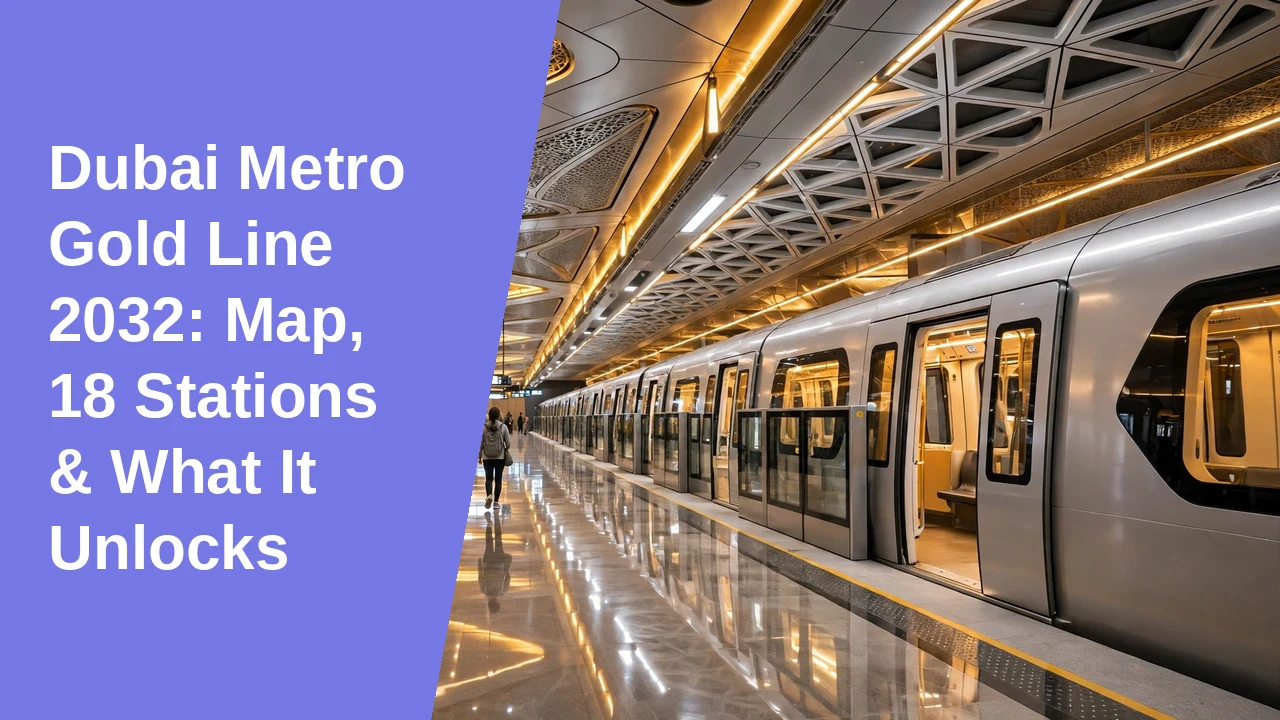
The Gold Line is Dubai Metro’s fourth line, a 42 kilometre fully underground route with 18 stations and an investment of about AED 34 billion. Sheikh Mohammed bin Rashid approved it on 22 April 2026, and RTA calls it the emirate’s largest sustainable transport project. It runs up to 40 metres deep, which makes it Dubai’s first fully underground metro line. The line will grow the Metro network from 120 kilometres and 67 stations, counting the Blue Line, to 162 kilometres and 85 stations, a 35% increase.
To put the size in context, the network you ride today is 120 kilometres long, and the Gold Line alone adds 42 kilometres, more than a third of the current network in a single line. The Blue Line, which is under construction now, adds 30 kilometres. Together the two new lines take the network from two lines to four, and from 53 distinct stations today to 85 stations once both open. The Gold Line is also the first line built entirely underground, where the Red and Green Lines run mostly on elevated track and the Blue Line mixes underground and elevated sections.
| Fact | Gold Line | Source |
|---|---|---|
| Length | 42 km, fully underground | RTA, 22 April 2026 |
| Stations | 18 planned, no official list yet | RTA, 22 April 2026 |
| Investment | About AED 34 billion | RTA, 22 April 2026 |
| Depth | Up to 40 metres | RTA, 22 April 2026 |
| Approved | 22 April 2026 | RTA, 22 April 2026 |
| Target opening | 9 September 2032 | RTA, 22 April 2026 |
| Status | Approved, tender in 2026 | RTA, 22 April 2026 |
The route: Al Ghubaiba to Jumeirah Golf Estates
The Gold Line runs from Al Ghubaiba in old Dubai to Jumeirah Golf Estates in the south, through 15 strategic locations named by RTA. The table below lists the 11 route points RTA named, in the order the line runs through them. These are areas the line will serve, not confirmed station names, and RTA has not said how many stations sit between each point.
| Order | Route point | What is there |
|---|---|---|
| 1 | Al Ghubaiba | Green Line interchange, old Dubai |
| 2 | Mina Rashid | Port Rashid and the cruise terminal area |
| 3 | City Walk | City Walk and the Coca-Cola Arena area |
| 4 | Business Bay | Red Line interchange |
| 5 | Mohammed Bin Rashid City | District One and the Meydan area |
| 6 | Nad Al Sheba | Residential Nad Al Sheba |
| 7 | Mohammed bin Rashid Gardens | New residential gardens district |
| 8 | Meydan | Meydan Racecourse and Etihad Rail link |
| 9 | Al Barsha South | Residential Al Barsha South |
| 10 | Jumeirah Village Circle | JVC residential area |
| 11 | Jumeirah Golf Estates | Red Line and Etihad Rail interchange |
The table below lists what Google Maps shows around each confirmed route point, checked 13 Nov 2026. These are places that exist today, not Gold Line stations, and RTA has not confirmed a station location at any of them.
| Route point | Nearby places, checked on Google Maps |
|---|---|
| Al Ghubaiba | Al Fahidi Historical Neighbourhood, Al Ghubaiba Bus Station, Coins Museum, XVA Hotel |
| Mina Rashid | Queen Elizabeth 2 Hotel, Port Rashid cruise terminal, Mina Rashid Marina |
| City Walk | Coca-Cola Arena, The Green Planet, La Ville Hotel & Suites City Walk, Rove City Walk, Roxy Cinemas, Al Safa Street |
| Business Bay | JW Marriott Marquis, Taj Dubai, Bay Avenue, Bay Square, Dubai Water Canal promenade, The Opus |
| Mohammed Bin Rashid City | District One, Crystal Lagoon, 8.4 km cycling and jogging track |
| Nad Al Sheba | Nad Al Sheba Cycle Park |
| Meydan | Meydan Racecourse, The Meydan Hotel, Al Meydan Road |
| Jumeirah Village Circle | Circle Mall, Hessa Street |
| Jumeirah Golf Estates | Earth Course, Fire Course |
Mohammed bin Rashid Gardens and Al Barsha South are residential areas with no landmark points to list.
The route links old Dubai with the new districts in the south, and it is the first Metro line to run through the middle of the city rather than along Sheikh Zayed Road or the Creek. RTA says the line serves 15 strategic locations, so the 11 named points above are the main ones, with further stops between them that RTA has not named yet.
The 18 stations: what is confirmed and what is not
RTA has confirmed the Gold Line will have 18 stations, but it has not published an official station list. That is the single most important fact in this guide, because several websites already print full station lists as if they were official. They are not. What exists is the RTA 2032 network map, and a few guides have read predicted stops off that map. Those predictions are useful, but they are predictions, and RTA has not confirmed the exact location of every station.
No official station list exists. RTA has confirmed 18 stations, but it has not published their names, their order, or their exact locations. Any list you see today is a prediction read off the 2032 network map, not an RTA announcement. Come back here when RTA publishes the list, and this guide will be updated.
Time Out Dubai read the 2032 network map in October 2026 and predicted stops at Al Mina Street, two in Satwa, one near the Satwa Bus Station and one on Al Satwa Road, then Global Village, a future Meydan Etihad Rail interchange, and Dubai Miracle Garden. Those predictions match the route points RTA named, and they explain why the topic of this guide keeps coming up in searches. But the map reading is not an announcement, and station names can change under naming rights agreements before the line opens, as they have on the Red and Green Lines. Other guides go further and publish station codes, such as G01 to G14, and claim four extra stations will be named in 2027. RTA has issued no such codes, so do not rely on them. The honest position is simple: 18 stations are planned, the corridor is set, and the names will be confirmed as the project moves from approval into delivery.
The interchanges: Red Line, Green Line and Etihad Rail
The Gold Line meets the Green Line at Al Ghubaiba, the Red Line at Business Bay and Jumeirah Golf Estates, and Etihad Rail at Meydan and Jumeirah Golf Estates. These five connections are what make the line useful, because they tie the new corridor into the network you already ride and the national railway.
Al Ghubaiba, on the Green Line in old Dubai, is where the Gold Line starts. Change here and you reach Deira, the Gold Souk and the Creek on the Green Line, or the historic centre on foot. Business Bay, on the Red Line, is the mid-route interchange, linking the Gold Line to Downtown, the Burj Khalifa and Dubai Mall in one direction and the Marina and Jebel Ali in the other. Jumeirah Golf Estates, at the southern end, becomes the biggest hub on the new line: the Red Line, the Gold Line and Etihad Rail all meet there, so it is the point where a Metro trip can become a train to Abu Dhabi or Fujairah. Meydan is the second Etihad Rail link RTA named, at a future passenger station. Use the Metro Map to see the network today, and the Etihad Rail Fare and Time Calculator for the national railway.
RTA also says the Gold Line will introduce loops, so passengers can travel short and long distances across the network without doubling back through the centre. That matters because the Red Line today carries most cross-city trips along Sheikh Zayed Road, and the Gold Line gives those trips a second route through the middle of the city. The five interchanges above are where the new line joins the old network, and each one shortens a journey that today needs a taxi or a bus.
What it brings within reach: Global Village, Miracle Garden and Satwa
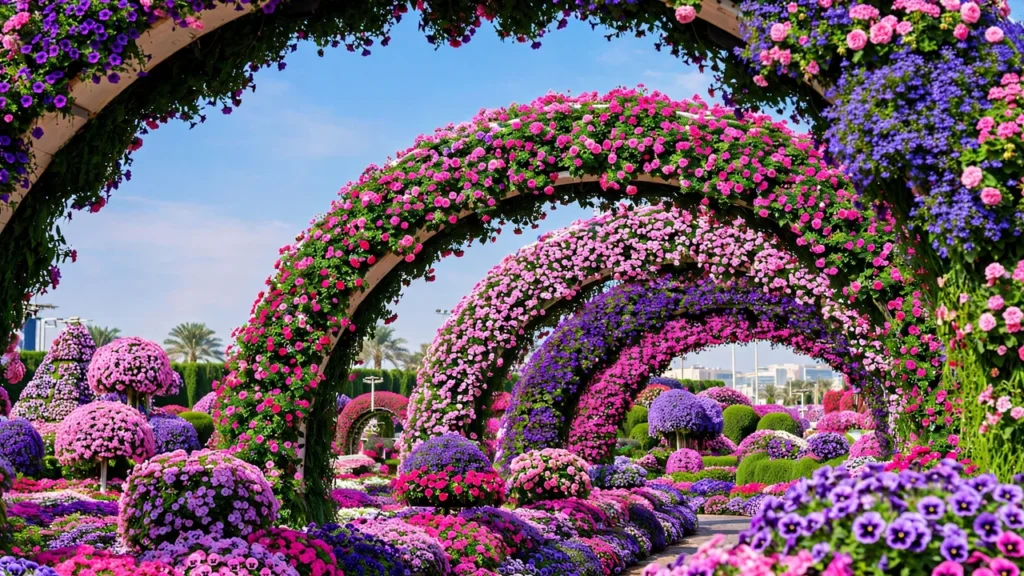
The Gold Line finally brings the Metro to places the Red and Green Lines never reached, including Global Village, Dubai Miracle Garden and Satwa. These are the three names that explain why people search for the Gold Line, and they are all predicted stops read off the 2032 network map, not confirmed stations. Treat them as the likely win, not a promise.
Satwa gets its first Metro service, with two predicted stops, one near the Satwa Bus Station and one on Al Satwa Road. Satwa is one of the oldest and most densely populated areas in Dubai, and today it is a bus or taxi ride from the nearest Metro station. A stop at the bus station would also give intercity travellers a direct Metro link. Global Village, which draws about 10 million visitors a year according to 2026 guides, has never had a Metro stop, and today you reach it by RTA bus from Mall of the Emirates station. A predicted Gold Line stop would turn a seasonal bus trip into a year-round Metro ride. Dubai Miracle Garden sits beside Global Village, and the map shows a stop there too. Jumeirah Village Circle and Dubai Hills, two of the largest residential areas with no Metro today, also sit on the corridor, and a station in either would cut thousands of car trips a day. Until RTA confirms the station list, the right way to read all of this is that the map points the right way, and the names will follow.
Who it serves: 1.5 million people and 55 projects
RTA says the Gold Line will serve more than 1.5 million people by 2040, across 55 development projects under construction. Those two figures are the reason the line exists: the corridor it runs through is where Dubai is building now, and the Metro is being built to meet the people moving in. Daily passenger numbers are expected to reach 465,000 beyond 2040, which would make the Gold Line one of the busiest single lines on the network. The network as a whole grows from 120 kilometres and 67 stations, counting the Blue Line, to 162 kilometres and 85 stations, a 35% increase. Every figure in this section is an RTA projection, not a count of people riding today, and the dates matter: the 1.5 million figure is for 2040, and the 465,000 daily riders figure is for beyond 2040.
The demand is already there. Since the Metro opened in September 2009, it has carried more than 2.8 billion passengers, and in 2025 alone it carried 295 million, up 7% on 2024. About one million people ride it on an average day, and the Metro now carries 40% of all public transport trips in the emirate. Those are RTA’s own figures, and they are why the network keeps growing: the Red and Green Lines are full at peak times, and the Blue and Gold Lines are the answer RTA has chosen.
Gold Line vs Blue Line
The Gold Line is bigger, deeper and later than the Blue Line, and the two lines do different jobs. The Blue Line runs east, through Festival City, Dubai Creek Harbour and Academic City, and it is under construction now. The Gold Line runs south-west, through Satwa, Business Bay and Meydan, and it is at the tender stage. Readers confuse the two future lines more than any other fact on this topic, so here they are side by side.
| Blue Line | Gold Line | |
|---|---|---|
| Length | 30 km | 42 km |
| Stations | 14 | 18 planned |
| Investment | About AED 20.5 billion | About AED 34 billion |
| Approved | 24 November 2023 | 22 April 2026 |
| Target opening | 9 September 2029 | 9 September 2032 |
| Underground or elevated | 15.5 km underground, 14.5 km elevated | Fully underground |
| Status | Under construction | Tender in 2026 |
The Blue Line opens first, on 9 September 2029, which is the 20th anniversary of the Dubai Metro opening. The Gold Line follows three years later, on 9 September 2032, and RTA says it will be delivered 30% faster than the Blue Line. For the full Blue Line facts, see our Blue Line guide.
The timeline: tender, contract, construction, opening
The Gold Line goes to tender in 2026, the contract is awarded in 2027, and construction follows, leading to the target opening on 9 September 2032. That is the whole official timeline, and it is short enough to list in full. The next milestone a reader can watch for is the tender result in 2026, then the contract award in 2027, and this guide will be updated when RTA announces either one.
| Milestone | Date | Status |
|---|---|---|
| Approved | 22 April 2026 | Done |
| Tender issued | 2026 | Next milestone |
| Contract awarded | 2027 | Planned |
| Construction | After contract award | Planned |
| Inauguration | 9 September 2032 | Target |
Large projects can move, and the opening date is a target, not a guaranteed travel date. The Blue Line is the comparison RTA itself uses: the Gold Line is scheduled to be delivered 30% faster than the Blue Line, which is why the six years from approval to opening look short for a 42 kilometre underground line.
Fares and zones: nothing is published yet
No Gold Line fare or zone is published, so this guide gives no ticket price for it. No ticket type is published either, and no one can tell you today what a Gold Line trip will cost. That will change as the opening gets closer, and RTA will publish fares and zones before the line opens. For reference, a trip on the Metro today costs AED 3, 5 or 7.50 on a Silver card depending on the zones you cross, and AED 6, 10 or 15 on a Gold card. A QR single costs AED 6, 8 or 10.50 on Regular and AED 10, 14 or 19 on Gold, and a day pass costs AED 22 or 42, including an AED 2 fee per transaction. No daily fare cap is published anywhere on RTA’s pages, so this guide states none. See the Fares Hub for the full tables, and the Fare Calculator to price a trip on the network today.
What to ride until 2032
Until 2032, every Metro trip in Dubai runs on the Red Line or the Green Line, and buses cover the places the Gold Line will reach. The network today has 53 distinct stations, and the two lines already reach most of the places visitors want. Global Village and Dubai Miracle Garden are reached by RTA bus from Mall of the Emirates station on the Red Line; check the timetable on the day, because the service is seasonal and the times change. Satwa is a short taxi or bus ride from Sharaf DG station on the Green Line. Use the Route Planner to check your own journey, the Metro Timings page for first and last trains, and All Stations for every station and zone. The Blue Line opens first, on 9 September 2029, and until then the Red and Green Lines are the whole Metro.
The Blue Line is worth watching first, because it opens three years before the Gold Line and it adds 14 stations in the east, through Festival City, Dubai Creek Harbour and Academic City. If you live or travel in that part of the city, the Blue Line changes your journeys in 2029, well before the Gold Line arrives. For the places on the Gold Line corridor, though, there is no earlier fix: Satwa, Global Village and Miracle Garden wait until 2032, and the bus is the answer until then.
The engineering: 40 metres down, fully underground
The Gold Line is Dubai’s first fully underground metro line, running up to 40 metres deep, built with tunnel boring machines. That is the engineering fact RTA announced, and it is what sets the Gold Line apart from the Blue Line, which is 15.5 kilometres underground and 14.5 kilometres elevated. Building entirely underground means no elevated track and minimal disruption to residents and existing developments, according to RTA, and the project follows the highest international standards of quality and safety. RTA has not published a tunnel diameter, a per-station depth, or a station design, so this guide gives none of those. What is known is the method: tunnel boring machines, the same technology used on metro projects around the world, digging the 42 kilometre route from Al Ghubaiba to Jumeirah Golf Estates.
Going underground also fits the corridor. The route passes through districts that are already built up, from old Dubai through Business Bay and Meydan to the southern suburbs, where an elevated line would need land and would cut across streets and buildings. A tunnel avoids that, at the cost of deeper stations and longer construction, which is part of why the line takes six years from approval to its target opening.
The money: AED 34 billion and the return RTA projects
The Gold Line costs about AED 34 billion, and RTA projects a 430% cumulative economic return over 20 years of operation. That return is a projection, not a result, and RTA says it comes from savings in time and fuel, fewer road accidents and lower carbon emissions. Property values near the stations are expected to rise by up to 20%, also an RTA projection, not an observed gain, so treat it as a forecast and not a promise. RTA also projects over 40 million fewer road journeys a year once the line runs, and 23% less congestion on the Red Line between BurJuman and Garmin. Note the RTA release still uses the old name ONPASSIVE for Garmin station, which was renamed in September 2026. The money figures are the reason the line is described as the emirate’s largest transport project, and they are also the figures most likely to be quoted without their source, so this guide keeps the source attached to each one.
What could change before 2032
The Gold Line is a plan with a target date, so the date, the station names and the order of works can all change before 2032. The opening date is a target, and large projects can move, so do not book travel around 9 September 2032 yet. Station names can change under naming rights agreements, as they have on the Red and Green Lines, where Al Khail became Max and ONPASSIVE became Garmin. The station list is not published yet and will be confirmed as the project advances, and the tender result in 2026 and the contract award in 2027 are the next facts to watch. This guide was checked on 13 Nov 2026 and will be updated when RTA announces the tender result, the contract award, or a station list. Until then, check rta.ae for the latest news on the line.
The Blue Line is the nearest example of how dates and details move. It was approved in November 2023 for a 2029 opening, and its station list is still not confirmed, three years after approval. The Gold Line is earlier in the same process, so expect the same pattern: the corridor and the date first, the station names and fares later, and updates here as each fact is confirmed.
Frequently asked questions
When does the Dubai Metro Gold Line open?
The target opening is 9 September 2032. That is a target set when the line was approved on 22 April 2026, not a guaranteed date. RTA will confirm the opening closer to the time, and the tender in 2026 and the contract award in 2027 are the next milestones to watch. Until then, you cannot ride the Gold Line or buy a ticket for it.
Where does the Gold Line run?
From Al Ghubaiba in old Dubai to Jumeirah Golf Estates in the south, through 15 strategic locations named by RTA, including Mina Rashid, City Walk, Business Bay, Mohammed Bin Rashid City, Nad Al Sheba, Meydan, Al Barsha South and Jumeirah Village Circle. The line is 42 km long and fully underground.
How many stations will the Gold Line have?
18 stations are planned, but RTA has not published an official station list, so no station names are confirmed. Some guides read predicted stops off the RTA 2032 network map, including two in Satwa, Global Village and Dubai Miracle Garden, but those are predictions, not confirmed stations.
Will the Gold Line serve Global Village and Dubai Miracle Garden?
It looks that way, but it is not confirmed. The RTA 2032 network map shows stops at both attractions, and Time Out Dubai read them off the map in October 2026. RTA has not confirmed the exact location of every station, so treat both stops as predicted until RTA publishes a station list. Today you reach both by RTA bus from Mall of the Emirates station.
How much will a Gold Line ticket cost?
No Gold Line fare, zone or ticket type is published, so there is no ticket price to give. For comparison, a trip on the Metro today costs AED 3, 5 or 7.50 on a Silver card depending on the zones you cross. See the Fares Hub on this site for the full tables, and check rta.ae when RTA publishes Gold Line fares.
How is the Gold Line different from the Blue Line?
The Gold Line is longer, deeper and later. It is 42 km with 18 stations, fully underground, approved 22 April 2026, with a target opening of 9 September 2032 and an investment of about AED 34 billion. The Blue Line is 30 km with 14 stations, part underground and part elevated, approved 24 November 2023, under construction now, with a target opening of 9 September 2029.